SoFi's Loan Losses Pile Up as Even Wealthy Borrowers Default - Bloomberg
Social Finance Inc.’s online borrowers are defaulting at higher rates than underwriters for one of its bond deals had expected,...
...The company started out refinancing student loans from graduates of top universities, and expanded into providing a broader range of services and products, from wealth management to insurance to mortgages, in some cases with partners....
...Non-bank startups arranged more than $36 billion of loans in 2015, mainly for consumers, up from $11 billion the year before...
Monday, March 13, 2017


To Take on Tesla, Sweden's NorthVolt Seeks $1 Billion Next Year - Bloomberg
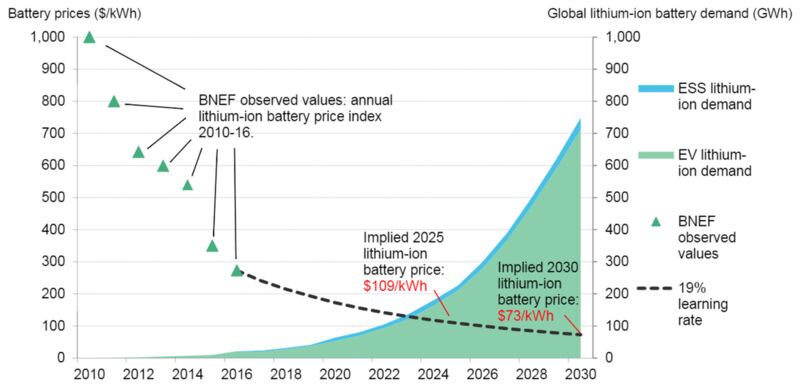
NorthVolt’s initial facility in Sweden is planned to have capacity to produce about 8 gigawatt-hours of batteries per year, rising to 32 gigawatt-hours once the project is fully operational in about six years. The company expects to lower to cost of lithium-ion battery packs significantly, aiming to halve prices by 2022, Carlsson said.
Battery Prices Falling
“The scale that NorthVolt is talking about could certainly bring down the cost of battery packs,” said Logan Goldie-Scot, energy storage analyst at BNEF. He’s still “skeptical” that NorthVolt will be able to raise the 4 billion euros it needs.
https://www.bloomberg.com/news/articles/2017-03-13/to-take-on-tesla-sweden-s-northvolt-seeks-1-billion-next-year
Sunday, March 12, 2017
Housing Bubble Déjà Vu - Project Syndicate (Mark Roe)
The 2008-2009 financial crisis exposed a serious weakness in the global financial system’s architecture: an overnight market for mortgage-backed securities that could not handle the implosion of a housing bubble. Some nine years later, that weakness has not been addressed adequately.
When the crisis erupted, companies and investors in the United States were lending their extra cash overnight to banks and other financial firms, which then had to repay the loans, plus interest, the following morning. Because bank deposit insurance covered only up to $100,000, those with millions to store often preferred the overnight market, using ultra-safe long-term US Treasury obligations as collateral.

But overnight lenders could command even higher interest rates if they took as collateral a less-safe mortgage pool, so many did just that. Soon, America’s red-hot housing market was operating as a multi-trillion dollar money market.
It soon became clear, however, that the asset pools underpinning these transactions were often unstable, because they comprised increasingly low-quality mortgages. By 2009, companies were in a panic. They balked at the idea of parking their cash overnight, with mortgage pools as collateral. This left the financial system, which had come to depend on that cash, frozen. Lending dried up, fear intensified, and the economy plunged into recession...
https://www.project-syndicate.org/commentary/us-housing-market-regulation-mortgage-pools-by-mark-roe-2017-03?utm_source=Project+Syndicate+Newsletter&utm_campaign=c22bb49d7a-the_sunday_newsletter_3_12_2017&utm_medium=email&utm_term=0_73bad5b7d8-c22bb49d7a-93854061#comments
Trade Truths for Trumpians and Brexiteers - Project Syndicate (Jim O'Neil)
...data on Germany’s total exports and imports in 2016 indicate that its largest trading partner is now China. France and the United States have been pushed into second and third place.
This news should not come as a surprise. I have often mused that, by 2020, German companies (and policymakers) might prefer a monetary union with China to one with France, given that German-Chinese trade would likely continue to grow.
...a country is likely to conduct more trade with big countries that have strong domestic demand, rather than with smaller countries that have weak demand.
...even if Brexit is not the UK’s biggest economic-policy challenge today, it will likely exacerbate other problems, including persistently low productivity growth, weak education and skills-training programs, and geographic inequalities.
https://www.project-syndicate.org/commentary/trade-truths-trump-brexit-by-jim-o-neill-2017-03?utm_source=Project+Syndicate+Newsletter&utm_campaign=c22bb49d7a-the_sunday_newsletter_3_12_2017&utm_medium=email&utm_term=0_73bad5b7d8-c22bb49d7a-93854061#comments
Some Start-Up Insights (from Catalant Blog by Eric Kleinman)
...successive approximation beats postponed perfection...
...Incubators also provide a fertile recycling ground. Startups that fail can have their assets repurposed, with people and technology being absorbed into other startups...
http://blog.gocatalant.com/incubators-how-corporations-can-access-innovation/
...Incubators also provide a fertile recycling ground. Startups that fail can have their assets repurposed, with people and technology being absorbed into other startups...
http://blog.gocatalant.com/incubators-how-corporations-can-access-innovation/
Wednesday, March 8, 2017
Northern Ireland Must Choose Stability Over Nationalism - Bloomberg View
Northern Ireland Must Choose Stability Over Nationalism - Bloomberg View
(Northern Ireland is the second largest recipient of EU funds by regional income)
(Northern Ireland is the second largest recipient of EU funds by regional income)
Subscribe to:
Posts (Atom)