Friday, August 18, 2023

China’s Abandoned Electric Cars Pile Up After EV Boom Fueled by Subsidies

China’s Abandoned Electric Cars Pile Up After EV Boom Fueled by Subsidies

China’s Abandoned, Obsolete Electric Cars Are Piling Up in Cities

A subsidy-fueled boom helped build China into an electric-car giant but left weed-infested lots across the nation brimming with unwanted battery-powered vehicles.

On the outskirts of the Chinese city of Hangzhou, a small dilapidated temple overlooks a graveyard of sorts: a series of fields where hundreds upon hundreds of electric cars have been abandoned among weeds and garbage.

Outrider Foundation logo
Visual media produced in partnership with Outrider Foundation.

Similar pools of unwanted battery-powered vehicles have sprouted up in at least half a dozen cities across China, though a few have been cleaned up. In Hangzhou, some cars have been left for so long that plants are sprouting from their trunks. Others were discarded in such a hurry that fluffy toys still sit on their dashboards.

The scenes recall the aftermath of the nation’s bike-sharing crash in 2018, when tens of millions of bicycles ended up in rivers, ditches and disused parking lots after the rise and fall of startups backed by big tech such as Ofo and Mobike.

This time, the cars were likely deserted after the ride-hailing companies that owned them failed, or because they were about to become obsolete as automakers rolled out EV after EV with better features and longer driving ranges. They’re a striking representation of the excess and waste that can happen when capital floods into a burgeoning industry, and perhaps also an odd monument to the seismic progress in electric transportation over the last few years.
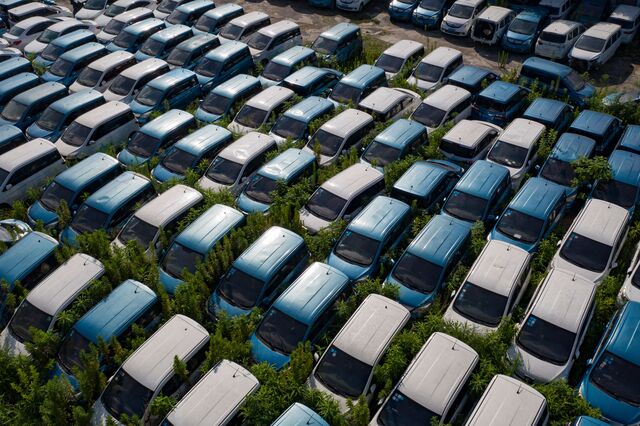
A view of a lot holding decommissioned electric vehicles in Hangzhou, China.
Among the weeds and rubbish, hundreds upon hundreds of electric vehicles lie unused. Photographer: Qilai Shen/Bloomberg

About a decade ago, encouraged by government subsidies, hundreds of automakers across China, both established players and startups, waded into electric-car manufacturing. They churned out huge numbers of early-stage EVs — relatively no-frills cars whose batteries in some instances could only run for around 100 kilometers (62 miles) on a charge.

Those vehicles were mostly bought by ride-hailing companies that leased them to drivers. “At the beginning of China’s EV market, delivery numbers were driven by car-sharing fleets,” said Young Huang, a senior analyst with JSC Automotive, a consultancy with offices in Shanghai and Stuttgart. “Only a few private customers chose to buy them.”

Ride-sharing bicycles piled up in Shanghai in Sept. 2017.
The scenes of disused electric vehicles are reminiscent of the nation’s bike-sharing crash from a few years ago. Photographer: Qilai Shen/Bloomberg

The demand helped juice an industry that has grown exponentially ever since. China is now the world leader in clean cars, producing around 6 million EVs and plug-in hybrids last year, or almost one in every three new cars sold domestically. It accounts for 60% of the world’s current electric fleet, and has the most extensive EV charging infrastructure on Earth — also built with government support.

But that lightning-fast development also left behind plenty of casualties. Many of the ride-hailing companies that were early adopters of EVs have gone out of business. There are now around 100 Chinese electric-car makers, down from roughly 500 in 2019.
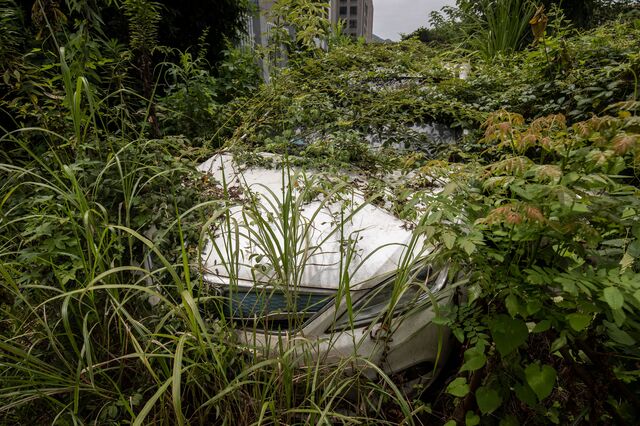
A view of a lot holding decommissioned electric vehicles in Hangzhou, China.
The pools of unwanted battery-powered cars are residue from rapid consolidation in the ride-hailing industry. Photographer: Qilai Shen/Bloomberg

The graveyards are a troubling consequence of that consolidation. Not only are the sites an eyesore, getting rid of EVs so quickly reduces their climate benefit considering they’re more emissions-intensive to build and only produce an advantage over combustion cars after a few years. Each of the vehicles’ spent batteries also contain precious ingredients like nickel, lithium and cobalt — metals that could be recycled to make China’s EV industry more environmentally friendly.

According to local media reports, the government of Hangzhou has vowed to dispose of the cars, which started to accumulate in 2019. But when Bloomberg News visited late last month, reporters uncovered several sites filled with abandoned EVs in the city’s Yuhang and West Lake districts after scouring satellite images and hacking through overgrown dirt paths.

A view of a lot holding decommissioned electric vehicles in Hangzhou, China.

In one field, more than 200 white cars — mainly battery-electric compact vehicles manufactured by Chongqing Changan Automobile Co. — were parked haphazardly. Body paint showed most of the cars were once operated by ride-hailing companies Didi Chuxing Technology Co. and Faststep Automobile Management.

Photographer: Qilai Shen/Bloomberg

All had blue plates, indicating they were made and registered before December 2017, when Hangzhou switched to green plates for new-energy vehicles. Registration stickers showed some would have been running on roads until as recently as 2021.

Photographer: Qilai Shen/Bloomberg

At a different site, near a river and along a deserted tram track, around 1,000 EVs sat gathering dust. Some had stickers from Ledao Chuxing, a ride-sharing company which shut down earlier this year. Others bore branding that indicated they belonged to Caocao Chuxing, a ride-hailing service owned by Hangzhou Youxing Technology Co.

Photographer: Qilai Shen/Bloomberg

The vehicles at this location were mainly produced by Changan, Zhejiang Geely Holding Group Co. and Dongfeng Motor Group Co., Nissan Motor Co.’s joint-venture partner in China.

Photographer: Qilai Shen/Bloomberg

Some cars were relatively new, with green plates and stickers on their windows reminding passengers to wear a mask to protect against Covid-19. Empty water bottles littered the back seats of others.

Photographer: Qilai Shen/Bloomberg

Before Tesla Inc. came to China and began making cars from its factory in Shanghai in early 2020, most EVs being produced in the world’s second-biggest economy were small and low quality. They were hardly appealing to consumers faced with a plethora of good-looking combustion engine cars.

To kick-start EV adoption, the government in the late 2000s began offering rebates of as much as 60,000 yuan ($8,400) per vehicle and restricting the ownership of gasoline cars in several major cities. Automakers backed or founded several ride-hailing startups, which in turn filled their fleets with their electric offerings.

Geely got behind Caocao Chuxing, for example, which is still operating. But another car-sharing service called Panda, backed by Chongqing Lifan Auto Co., folded and Lifan Auto itself filed for bankruptcy in 2020. It was acquired by Geely a year later. A brand of EVs called Maple, made by a joint venture between Geely and Lifan, was spotted at one of the sites Bloomberg News visited.

A view of a lot holding decommissioned electric vehicles in Hangzhou, China.
Encouraged by government subsidies, scores of automakers across China, both established companies and newer ones, waded into electric-car manufacturing. Photographer: Qilai Shen/Bloomberg

In the mid-2010s, China ramped up its push for EV adoption with a credit system that rewarded automakers for producing EVs and penalized the manufacturing of high fuel-consumption cars. A 2021 Fitch Ratings Inc. report raised the possibility that some companies started ride-hailing companies as an easy way to absorb their growing inventories of EVs that weren’t being bought by the public.

Some companies also began cheating the subsidy program by falsifying records for non-existent EVs. For example, they could produce an empty chassis that didn’t contain a battery, or make cars with batteries that didn’t meet the correct specifications. The official People’s Daily in 2016 cited estimates that dozens of companies had fraudulently claimed more than 9.3 billion yuan ($1.3 billion) in subsidies.

Beijing began slashing national subsidies for all electric car purchases in 2019. Many ride-hailing companies were unprepared for the policy change, which severely affected their cash flow. “Those players couldn’t survive,” Huang said.

The EV graveyards first started to draw public attention later that year, when internet users and local media reported on the phenomenon.

A view of a lot holding decommissioned electric vehicles in Hangzhou, China.
Each of the cars’ spent batteries contain precious ingredients like nickel, lithium and cobalt. Photographer: Qilai Shen/Bloomberg

Fitch Ratings’ director of China corporate research, Jing Yang, who was one of the authors of the agency’s 2021 report, says now she’s not surprised to hear the EV graveyards exist.

The adoption by taxi companies and fleet operators did a good job of educating consumers that EVs were safe alternatives, she said. It motivated manufacturers to invest in EV-related technologies at a time there wasn’t really a consumer market for them, laying the foundation for wider demand.

“This phenomenon concludes the past of China’s new-energy vehicle market, but speaks little for its future,” said Yang.

Geely, which controls Youxing, said in a statement that only about 40 of the cars were owned by Caocao and it had paid the landlord of the plot to store the cars until Aug. 19. The company said the vehicles, which are still road-worthy, will be sent to other cities.

Didi, Changan and Dongfeng Forthing, whose Jingyi S50 model was also spotted at one of the sites, did not reply to questions. China’s Ministry of Industry and Information Technology, which regulates EVs, did not respond to a fax. Calls to the Hangzhou government went unanswered.

A local media report from 2021 said Faststep’s cars were waiting to be auctioned off. The company’s official WeChat account has not been active since 2019 and phone numbers listed on an old post are no longer working.
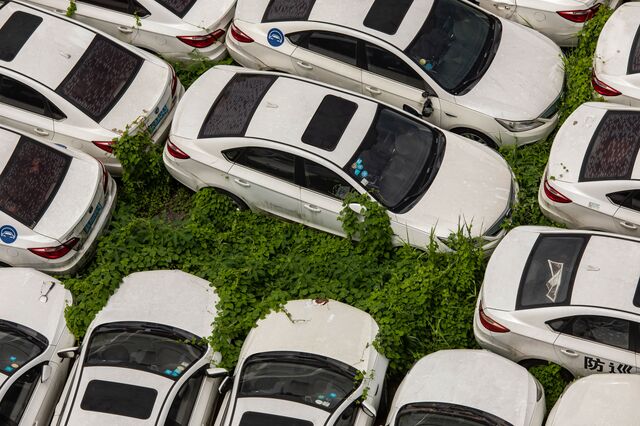
A view of a lot holding decommissioned electric vehicles in Hangzhou, China.
In 2019, Beijing slashed national subsidies for all electric car purchases by half, severely hitting the cash flows of ride-hailing companies. Photographer: Qilai Shen/Bloomberg

Shenzhen-based photographer Wu Guoyong was one of the first people in China to document the waste that results from frenetic development, taking striking drone shots of the piles of abandoned bicycles in 2018. In 2019, he filmed aerial footage of thousands of electric cars in empty lots around Hangzhou and Nanjing, the capital of China’s eastern Jiangsu province.

China’s capital market was small when the nation began opening up, he said in an interview, but now, unregulated financing is like a “tsunami.”

“The shared bikes and EV graveyards are a result of unconstrained capitalism,” Wu said. “The waste of resources, the damage to the environment, the vanishing wealth, it’s a natural consequence.”
—With Linda Lew, Chunying Zhang and Dan Murtaugh


Visual media produced in partnership with Outrider Foundation.

Tuesday, August 1, 2023

Island climate tech - btbirkett@gmail.com - Gmail

Island climate tech - btbirkett@gmail.com - Gmail

Bloomberg

Today’s newsletter looks at some of the progress Singapore has made in deploying technologies that will prove crucial for any island country’s survival in the 21st century. You can read the full story on Bloomberg.com. 

Akshat Rathi will be in Sydney on August 3. If you'd like to meet him over drinks, please let him know here.

Island technology 

By Sheryl Lee and Akshat Rathi 

Singapore has gone from a mudflat swamp with fishing villages to an island metropolis boasting one of the world’s highest incomes and population densities—in a little more than 150 years. It’s going to have to go through a different kind of transformation in less than 30 years, if it’s to meet its newly set goal of reaching net-zero emissions by 2050.

The formula to reach net-zero requires a country to move to carbon-free energy sources and capture any residual emissions that it cannot fully mitigate. But building renewables like solar and wind requires a lot of land, one thing Singapore doesn’t have. That’s why the country has floated the idea of importing renewable energy from other nations (even as far as Australia) through long undersea cables. But the high cost and technical hurdles behind such ideas means they have yet to fully come to fruition. The watchdog Climate Action Tracker currently rates the island country’s climate plan “critically insufficient.”

While Singapore’s gameplan has its critics, it’s made progress in several pockets that many small-island countries can learn from. Singapore has deployed and scaled up some of the technologies that will prove crucial for any island country’s survival in the 21st century. Last month, we got to tour a number of them.

District cooling

Five floors below the luxury shops at Marina Bay Sands, SP Group runs a giant cooler. It provides cooling to dozens of skyscrapers and developments in the vicinity, saving a huge amount of premium space in each building that would otherwise be taken by air conditioning equipment.

Below Singapore’s financial district, a thermal storage tank feeds the world’s biggest underground cooling system. Photographer: Wei Leng Tay/Bloomberg

Crucially, the bigger a cooling network, the more energy efficient it can be. In one test, when SP Group connected an existing building with its own cooling system, its energy use dropped 40%, said Foo Yang Kwang, SP Group’s chief engineer of sustainable energy solutions.

The plant can also act like a huge ice battery. During off-peak hours, such as at night, the plant has vast stores of water that can be cooled to near freezing temperatures. Then in the day, it can tamp down electricity consumption by using the freezing waters to supply the cooling network.

Offshore solar

As solar panels have become cheaper, they are finding use in all sorts of places. One promising application is to put them on top of bodies of water, which brings multiple advantages. Covering a reservoir reduces evaporation, while sitting atop water keeps panels cool and increases how much energy they can produce.

Singapore is also building floating solar on lakes and even its coast line. While an offshore solar farm could experience waves large enough to cause panels to break, that did not stop EDP Renewables APAC from investing in the idea. The company owns a 5-hectare floating solar farm in Johor Strait on the northern shore of Singapore where water disturbance is manageable.

A floating solar photovoltaic power plant in Singapore.  Photographer: Bryan van der Beek/Bloomberg

Built during the pandemic, the 5-megawatt peak solar plant makes use of plastic pontoons filled with air to hold the solar panels in place. However, the system is flexible enough that waves up to 2 meters simply pass through. The plant, which cost more than S$7.5 million ($5.6 million), is more expensive than what could be built on land elsewhere, but in Singapore there’s just not enough land to spare.

Water desalination

Singapore used to get most of its water from Malaysia, but that dependency is now down to only about half of its needed supply. The rest is made up using rainwater, recycling waste water, and making seawater drinkable. That last solution is hugely energy intensive, taking up 3.5 kWh of electricity for every 1,000 liters or about three times as much as would be needed to purify rainwater.

“With climate change, heat and water stresses are very real” especially for a tropical island, said Melissa Low, a research fellow at the National University of Singapore’s Center for Nature-based Climate Solutions. “Some energy-intensive technologies, like desalination, are crucial for Singapore, so we have to make them more energy efficient.”

The Keppel Marina East Desalination Plant in Singapore. Photographer: Ore Huiying/Bloomberg

Public Utilities Board, which is responsible for Singapore’s water management, has a long-term goal of reducing the energy use of water desalination to 1 kWh per 1,000 liters. That’s going to require using technologies still in their infancy. In a positive sign for feasibility, PUB says it has run a pilot plant that cuts energy-use of desalination down to 1.65 kWh, which is less than half the average of current technology.

“As a small, low-lying island, Singapore has its own unique circumstances and its decarbonization trajectory has to be different from other countries,” Low said. “Climate change is an existential issue for Singapore so we’re looking into as many solutions as we can.”