Wednesday, April 14, 2021

Cruise, self driving Taxis - Dubai 2023 - btbirkett@gmail.com - Gmail

A big shakeout is coming - btbirkett@gmail.com - Gmail

The Cruise Origin electric driverless shuttle.

Photographer: David Paul Morris/Bloomberg

GM unit Cruise plans to start running self-driving taxis in Dubai in 2023. The move marks Cruise's first location outside the U.S. — the unit will be the exclusive operator of these services in the largest city in the United Arab Emirates until 2029. 

Self-Driving Cars, the "trough of disillusionment," - A big shakeout is coming - btbirkett@gmail.com - Gmail

A big shakeout is coming - btbirkett@gmail.com - Gmail

A big shakeout is coming

The year 2020 was supposed to herald the arrival of self-driving cars. Instead, we got a global pandemic and growing recognition that autonomous vehicles are an incredibly hard, and expensive, challenge.

It’s a challenge still worth pursuing. More than 42,000 people are estimated to have died in crashes on U.S. roadways in 2020, according to preliminary estimates from the National Safety Council. That’s a stunning figure given that so many people worked from home and gave up commuting last year.

And if you believe, as I do, that the DARPA Urban Challenge of November 2007 really kickstarted the autonomous vehicle industry, it is humbling to realize that roboticists have been working on this for nearly 14 years. Reporter Alex Davies has written Driven, a wonderful book about this history that you should check out.

In California, 56 companies from Apple to Zoox have permits from the state’s Department of Motor Vehicles to test their autonomous vehicles with a human safety driver behind the wheel. Seven, including Cruise, Waymo and Zoox, have advanced to permits without a human driver. Just one — Nuro — has received a permit to deploy and operate vehicles commercially.

It seems pretty clear that not all 56 companies are going to survive in their current form.

“The space has been ripe for consolidation for a while,” Asad Hussain, a mobility analyst at PitchBook, told me. “It’s more technologically difficult and capital-intensive than people realize. To really commercialize at scale, we think you need $6 billion to $10 billion for technical development.”

Indeed, Argo AI, an autonomous partner to Ford and VW, is looking at a public offering as early as this year to raise the billions necessary to commercialize its self-driving system in 2022.

And consolidation has already begun. GM acquired Cruise, and last month Cruise acquired Voyage. Amazon acquired Zoox. Aurora acquired Blackmore and then OURS Technology, key suppliers of lidar. 

There’s also a bit of a shakeout when it comes to another key measure: talent. John Krafcik’s departure from Waymo after five and a half years at the helm raises a lot of questions about business models and corporate patience. The departure was announced on Good Friday, and Tekedra Mawakana and Dmitri Dolgov will be co-CEOs going forward, and it’s telling to me that Waymo hasn't updated its website yet with this information.

The hype cycle for autonomous vehicles kicked off in earnest in 2015. On the eve of that year's Consumer Electronics Show in Las Vegas, Mark Fields — then the CEO of Ford — predicted that self-driving cars would be on the road in five years, making him the first big-name CEO to put that stake in the ground. In 2016, Elon Musk said that Tesla would demonstrate a fully autonomous Los Angeles-to-New York trip by the end of 2017, another deadline that has come and gone.

Mike Ramsey, a senior mobility and transportation analyst at Gartner, was the lead author of Gartner’s 2018 “Hype Cycle for Connected Vehicles and Smart Mobility” report. The report plots technologies’ maturity against the hype they are receiving, with the idea that technologies are hyped far ahead of when they actually arrive. The Gartner report said that autonomous vehicles had plunged into the "trough of disillusionment," which remains one of my favorite phrases of all time. The Hype Cycle report is updated every year, and AVs are still in the trough.

“Consolidation is part of the trough of disillusionment,” Ramsey said when we caught up recently. “Top-tier companies will be acquired, second-tier companies will change directions and bottom-tier companies will just run out of money.”


Monday, April 12, 2021

Microsoft Makes Big Bet on Health-Care AI Technology With Nuance - Bloomberg

Microsoft Makes Big Bet on Health-Care AI Technology With Nuance - Bloomberg

Microsoft Makes Big Bet on Health-Care AI Technology with Nuance

By Dina Bass, Liana Baker, and Kiel Porter

April 11, 2021, 8:31 PM EDT


Microsoft Corp. is making a massive bet on health-care artificial intelligence.


The software giant is set to buy Nuance Communications Inc., tapping the company tied to the Siri voice technology to overhaul solutions that fdsce Microsoft may announce the deal as soon as Monday if talks are successful, according to people familiar with the matter.


The price being discussed could value Nuance at about $56 a share, a 23% premium to Friday’s close, said one of the people, who asked not to be identified because the information is private. Set to be Microsoft’s largest acquisition since LinkedIn Corp., the purchase would give Nuance an equity value of about $16 billion, data compiled by Bloomberg show.


Microsoft has been trying to make inroads into the health-care sector, selling more cloud software to hospitals and doctors. It has been working with Nuance for two years on AI software that helps clinicians capture patient discussions and integrate them into electronic health records, and combining the speech technology company’s products into its Teams chat app for telehealth appointments.


The “Nuance deal would be a trophy for Redmond,” said Wedbush analyst Dan Ives, referring to Redmond, Washington-based Microsoft. “Nuance is in the midst of an unprecedented strategic turnaround the last few years under the leadership of CEO Mark Benjamin and we believe the company represents a unique asset on the health-care front for Microsoft.”


Under Benjamin, Nuance has narrowed its focus and separated peripheral businesses, such as Cerence Inc., the automotive AI unit that was spun off two years ago. It also sold its imaging division to Thoma Bravo’s Kofax for $400 million, and zoomed in instead on partnerships with health-care providers and the biggest electronic medical records companies.


A representative for Microsoft declined to comment. A spokesperson for Nuance, based in Burlington, Massachusetts, didn’t immediately respond to a request for comment.


Digitizing Healthcare

Nuance’s shares have climbed 3.4% this year, giving the company, which laid the groundwork for the technology used in Apple Inc.’s Siri, an almost $13 billion market value. The gain still trailed the 9.9% jump in the S&P 500 Index, while Microsoft added 15%.


As AI software gets better at parsing language and predicting medical needs, Nuance and Microsoft may be able to develop technology that searches for certain words in health records to make better suggestions to doctors for patient care.


“This can really help Microsoft accelerate the digitization of the health-care industry, which has lagged other sectors such as retail and banking,” said Anurag Rana, a Bloomberg Intelligence senior analyst. “The biggest near-term benefit that I can see is in the area of telehealth, where Nuance transcription product is currently being used with Microsoft Teams.”


Nuance, whose products include Dragon speech-recognition software, had net income of $91 million on revenue of $1.48 billion for its fiscal year ending Sept. 30., after losing $217 million the previous year.


Microsoft has also been increasingly focused on healthcare. In May, the software maker unveiled a package of industry-specific cloud software, and has also hired executives with medical backgrounds and researching machine learning and AI tools for areas including clinical trials.


Coincidentally, one of Microsoft’s Boston area offices is located right next to Nuance’s headquarters.


Still Active

With a market value of $1.93 trillion, the most in the world after Apple, Microsoft remains active on the deals front.


Last month, Bloomberg News reported that the software giant was in talks to acquire Discord Inc., a video-game chat community, for more than $10 billion. It also bought video-game maker Zenimax Media Inc. for $7.5 billion in cash in a deal that closed this year.


The Nuance purchase would rank as Microsoft’s second-largest acquisition, behind the 2016 LinkedIn purchase at an equity value of more than $26 billion, according to data compiled by Bloomberg.


Microsoft entered the artificial intelligence space decades ago with research projects and an early focus by co-founder Bill Gates on finding ways to make it easier for people to speak to computers using plain English.


The Nuance purchase will complement efforts in recent years, where Microsoft has assigned thousands of employees to its AI work and released tools customers can use to build applications that understand and translate speech, recognize images and detect anomalies. The company views AI as a key driver of future sales of cloud services.


The acquisition may also give Microsoft a boost as it faces fierce competition in the AI space with rivals such as Alphabet Inc.’s Google and Amazon.com Inc. also investing heavily in the field.


Vaccines & Chile: Sinofarm-Goldilocks Markets Should Brace for a Testing Week - btbirkett@gmail.com - Gmail

Goldilocks Markets Should Brace for a Testing Week - btbirkett@gmail.com - Gmail

Vaccines and Their Limits

The two countries outside the Arabian Gulf to have vaccinated most swiftly are Chile and Israel. At first glance their divergence is hard to explain. Israel has brought Covid impressively under control, while Chile has been forced to postpone elections scheduled for this weekend:

This may not be as worrying as it first appears. This is from Andrew Brigden of Fathom Financial Consulting: 

Chile began reopening its economy late last year, and until recently there were very few restrictions on movement, with international travel permitted, and schools, restaurants and non-essential shops allowed to open. It appears that the authorities were relying on the vaccine alone to prevent transmission, even though it takes time for immunity to build. There are also doubts regarding the efficacy of the Chinese Sinovac vaccine, which accounts for the vast majority of doses administered in that country. Back in January, researchers in Brazil found that it was only 50% effective in preventing symptomatic infection. The situation in Chile needs monitoring, but for now we take the view that the pick-up in cases, to a level well below the peaks seen around the turn of the year in Israel, the UK or the US, is unlikely to signify the emergence of a new, vaccine-avoiding strain. Instead, it is probably the consequence of a country seeking to return to normal too quickly, protected largely by a vaccine that barely meets the efficacy requirements of the WHO.

Saturday, April 10, 2021

‘A woman of almost awesome chic’ — the dazzling Elsa Peretti | Christie's

‘A woman of almost awesome chic’ — the dazzling Elsa Peretti | Christie's


‘A woman of almost awesome chic’ — the dazzling Elsa Peretti

The fearless designer wowed 1970s New York with her brilliantly inventive jewellery — from the bone cuff to the bean pendant, the open heart necklace to the mesh scarf. Christie’s specialist Marie-Cécile Cisamolo pays tribute to a true original

In the late 1960s, Elsa Peretti (1940-2021) was one of the most successful models in New York, working with the provocative photographers Helmut Newton and Hiro. With her statuesque physique, severe cropped hair and khaki-coloured eyes, she stood out among the fresh-faced ingénues of Park Avenue. 

‘She is a woman of almost awesome chic, looking as dazzling in a beat-up men’s fedora as she does in a Halston ball gown,’ wrote the fashion critic Bernadine Morris in the 1978 book The Fashion Makers.

However, for all the glamour and success modelling brought her, the ferociously independent Peretti had other ideas. ‘She was quoted as saying that modelling was just a job to pay the bills,’ says Marie-Cécile Cisamolo, a specialist in Christie’s Jewellery department. 

‘But she was clearly very good at it — the photograph of her wearing bunny ears by her lover Helmut Newton is to die for. Her real passion, though, was design.’

Over the next decade, Peretti re-fashioned herself as one of the most successful and unorthodox jewellery designers of the 1970s. Inspired by forms found in the natural world — such as scorpions, flowers and bones — her clean, minimalist designs became highly sought-after. 

‘She was a trailblazer,’ says Cisamolo, ‘a strong feminist who ignored the boundaries between fine and costume jewellery, creating pieces that the working woman could afford.’

Tiffany & Co. Elsa Peretti black jade and gold ‘Sevillana’ bangle bracelet. Inner circumference 15.3 cm (6 in). Estimate $3,000-5,000. Offered in Jewels Online, 8-20 April 2021

Tiffany & Co. Elsa Peretti black jade and gold ‘Sevillana’ bangle bracelet. Inner circumference: 15.3 cm (6 in). Estimate: $3,000-5,000. Offered in Jewels Online, 8-20 April 2021

 
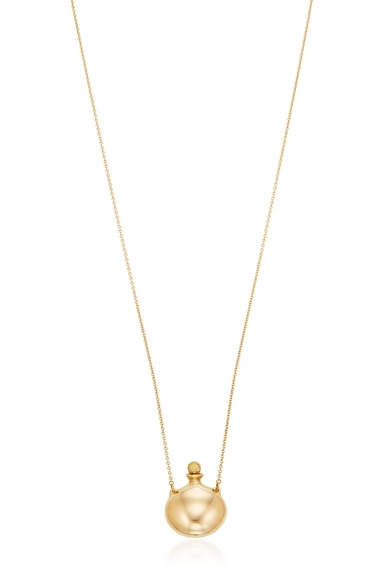
Tiffany & Co. Elsa Peretti coloured diamond and gold bottle pendant necklace. Necklace 73.4 cm (29 in). Pendant 3.5 x 2.7 cm (1⅜ x 1¼ in). Estimate $3,000-5,000. Offered in Jewels Online, 8-20 April 2021

Tiffany & Co. Elsa Peretti coloured diamond and gold bottle pendant necklace. Necklace: 73.4 cm (29 in). Pendant: 3.5 x 2.7 cm (1⅜ x 1¼ in). Estimate $3,000-5,000. Offered in Jewels Online, 8-20 April 2021

Peretti, who died in March aged 80, was born in Florence in 1940. Her father was head of the large oil company Anonima Petroli Italiana, and her upbringing was divided between schooling in Rome and Switzerland, and skiing with the Italian aristocracy in Gstaad. 

At 21, she declared her independence by writing to her father, ‘I am a major adult and free, and I decide to live a life.’ He took her at her word and cut her off financially: she left Rome for Barcelona, penniless.

Thanks to her angular beauty and striking physique, she attracted the attention of the Catalan avant-garde and became part of Salvador Dalí’s eclectic entourage. He introduced her to Surrealism, which was to have a decisive impact on her jewellery designs.

In 1968, her modelling career took her to New York. ‘She famously arrived in Manhattan with a black eye from her boyfriend, who didn’t want her to go,’ says Cisamolo.

Helmut Newton (1920-2004), Elsa Peretti in a Bunny costume by Halston, New York, 1975. Gelatin silver print, printed later. 22⅞ x 15⅛ in (58.2 x 38.4 cm). Sold for $79,000 on 10 April 2008 at Christie’s in New York. © The Helmut Newton Estate  Maconochie Photography
Helmut Newton (1920-2004), Elsa Peretti in a ‘Bunny’ costume by Halston, New York, 1975. Gelatin silver print, printed later. 22⅞ x 15⅛ in (58.2 x 38.4 cm). Sold for $79,000 on 10 April 2008 at Christie’s in New York. © The Helmut Newton Estate / Maconochie Photography

She soon became close to a tight-knit circle of artists and stars, among them Andy Warhol, Bianca Jagger, Bob Colacello and Liza Minnelli, and later hung out at the celebrity hotspot Studio 54. With her husky voice, androgynous appearance and trademark large sunglasses, she cut an imposing figure on the dance floor. She is portrayed in Warhol’s diaries as a fiery character who liked a party.

Peretti was naturally drawn to artists, says Cisamolo: ‘She was very knowledgeable about modern art. It was one of the things that struck me about her designs when I first saw them. You can see the influence of Surrealism, Abstraction and Minimalism.’

In 1969, Peretti showcased her first items of jewellery alongside the collection of her friend, the Italian designer Giorgio di Sant’ Angelo (1933-1989). She created a little silver vase that hung around the neck on a string of leather. ‘It became an instant hit — everyone wanted one,’ says the specialist.

‘To be a named jewellery designer in the 1970s was rare, particularly if you were a woman. But Tiffany understood her appeal’ — specialist Marie-Cécile Cisamolo

However, it was her relationship with the American fashion designer Halston (1932-1990), the focus of a forthcoming Netflix drama featuring Ewan McGregor and Rebecca Dayan, that was to have the most profound impact on her career. ‘He was a great man,’ Peretti said in 1990. ‘I learned so much from him.’

‘Halston and Elsa made an incredible team,’ says Cisamolo. ‘They were instantly attracted to one another. He loved her aristocratic background and she was attracted to his New World mentality. I think they also saw themselves as outsiders in New York.’

She was his muse, model and collaborator, working on a range of make-up and a fragrance bottle in the shape of an asymmetrical teardrop that was so distinctive it had no need for the Halston label.

In 1974, Halston introduced Peretti to the CEO of Tiffany & Co., who was looking to expand the brand’s customer base and was happy to consider selling silver, Peretti’s material of choice.

Tiffany & Co. Elsa Peretti gold bone cuff bracelet. 15.5 cm continuous inner circumference with 2.8 cm opening, 5.5 cm widest point. Sold for $6,875 on 13 December 2019 at Christie’s
Tiffany & Co. Elsa Peretti gold ‘bone’ cuff bracelet. 15.5 cm continuous inner circumference with 2.8 cm opening, 5.5 cm widest point. Sold for $6,875 on 13 December 2019 at Christie’s

‘She was in the right place at the right time with the right idea,’ notes Cisamolo. In the 1970s, designers were seeking to democratise the luxury market: Peretti was one of a group of jewellery makers, including Angela Cummings (b. 1944) and Aldo Cipullo (1942-1984), who wanted to create beautiful but affordable pieces.

Peretti asked that her designs be named, and Tiffany & Co. agreed. Today all of her pieces are stamped with the ‘PERETTI’ logo in block capitals. ‘It shows a real strength of character,’ says Cisamolo. ‘To be a named jewellery designer in those days was rare, particularly if you were a woman. But Tiffany understood her appeal.’

One of her earliest designs for Tiffany was the ‘bone’ cuff, inspired by the bones from a 17th-century Capuchin church. ‘It had this sculptural power but was also feminine,’ says the specialist. Its hard-edged aesthetic was perfect for the second-wave feminist woman who wasn’t going to wait around to be bought jewellery. Soon Liza Minnelli and Sophia Loren were spotted wearing them.

Two Tiffany & Co. Elsa Peretti open heart necklaces. Pendants 2.7 x 2.3 cm and 3.5 x 3.2 cm. Chains 40.5 cm and 72.5 cm. Sold for $1,875 on 4 October 2018 at Christie’s
Two Tiffany & Co. Elsa Peretti ‘open heart’ necklaces. Pendants: 2.7 x 2.3 cm and 3.5 x 3.2 cm. Chains: 40.5 cm and 72.5 cm. Sold for $1,875 on 4 October 2018 at Christie’s

Other innovations included the bean pendant, the silver mesh scarf and the now iconic open heart necklace, which became Tiffany’s most popular piece. Its form was inspired by the negative space in a Henry Moore sculpture. Her real stroke of genius, however, was her ‘diamonds by the yard’ necklace.

‘She took these tiny diamonds and set them at different lengths on the thinnest of chains,’ explains Cisamolo. ‘Women loved it because it was fun and lit up the décolletage.’ In fact, so popular did the necklace become that the firm felt obliged to raise the price to ensure it retained something of its exclusivity.

Tiffany & Co. Elsa Peretti diamonds by the yard diamond necklace. 41.0  cm. Sold for HK$43,750 on 6 November 2018 at Christie’s
Tiffany & Co. Elsa Peretti ‘diamonds by the yard’ diamond necklace. 41.0 cm. Sold for HK$43,750 on 6 November 2018 at Christie’s

By 1978 Peretti was Tiffany’s leading designer, and at the highest point her pieces were said to generate 10 per cent of the company’s yearly revenue. ‘Everything she touched, women wanted,’ says Cisamolo. ‘At that time she was experimenting with gold, jade and lacquer, materials she had studied intensively on her travels in Japan and India.’

Then suddenly, at the height of her popularity in the 1980s, Peretti left New York. ‘She burnt out working too hard and living too fast,’ says the specialist. ‘She realised that if she didn’t escape she wouldn’t survive. The AIDS crisis had hit, and many of her friends were dying.’

Peretti moved to Sant Martí Vell, an ancient, abandoned village in Catalonia, Spain, near to where the silversmiths and craftsmen who worked on her designs were based. With no running water, she washed in the street and slept on a bench. She embarked on an ambitious renovation project that spanned 40 years and inspired her to branch out into homeware, with pieces in china, crystal and silver.

A silver candlestick, designed by Elsa Peretti, mark of Tiffany & Co. 15 in (38 cm) high. Sold for $1,500 on 17 May 2011 at Christie’s in New York

In 2012, she renegotiated her contract with Tiffany & Co. for another 20 years and was paid $47 million. Not that Peretti needed the money: when her father died, he left her shares in his business. She sued for more from her sister and ended up with 49 per cent. With it she created the Nando Peretti Foundation, later renamed The Nando and Elsa Peretti Foundation, which supports many environmental projects that were close to her heart.

Sign up today

Christie’s Online Magazine delivers our best features, videos, and auction news to your inbox every week

Subscribe

Today, Peretti’s jewellery is still extremely popular. ‘She appeals to women at all stages of life,’ says Cisamolo, who expects the market for her pieces to rise over the next few years. ‘The Tiffany Peretti collaboration is so much a part of the brand, I can’t see them stopping production any time soon.

‘She had an old soul and brought an Old-World European sensibility to hard-edged New York. The result was this perfect storm of beauty.’

The shared passion of Elaine and Alexandre Rosenberg | Christie's

The shared passion of Elaine and Alexandre Rosenberg | Christie's

Inside the 300m exploration vessel complete with a "science sphere" and 22 onboard laboratories

Inside the 300m exploration vessel complete with a "science sphere" and 22 onboard laboratories

Inside the 300m science exploration vessel complete with a "science sphere" and 22 on board laboratories

8 APRIL 2021BY MIRANDA BLAZEBY

A 300-metre science exploration vessel packed with green technology, a “science sphere”, and the capacity to hold more than 400 people on board has been revealed.

earth-300-exploration-vessel-revealed

Penned by Iddes Yachts, Earth 300 is described as a vessel “that will unite science and exploration to confront earth’s greatest challenges," by Iddes Yacht founder Ivan Salas Jefferson.

earth-300-exploration-vessel-revealed

The vessel will act as an extreme technology platform for science, exploration and innovation at sea, incorporating robotics, AI and 22 state-of-the-art on board laboratories.

“The ship will introduce features found on cruise, expedition, research and luxury yachts but she will be none of them,” said Earth 300 chief executive Aaron Olivera.

earth-300-exploration-vessel-revealed

Featuring naval architecture by NED, Earth 300 will be emission-free and powered by Molten Salt Reactors, which provide sustainable, clean energy.

Other features include a science city housed inside a huge sphere, an observation deck, a 46-metre beam and an interior dedicated to scientific research and expedition. The vessel will also carry a selection of advanced underwater vehicles.

Accommodation will be for a total of 160 scientists, 20 experts-in-residence, 20 students, 40 VIP guests and 165 crew.

earth-300-exploration-vessel-revealed

Led by chief executive Olivera, the Earth 300 project is supported by a number of partners including IBM, RINA, Triton Submarines and EYOS Expeditions.

The preliminary vessel design and naval engineering are now complete, with Earth 300 projecting a launch date of 2025.