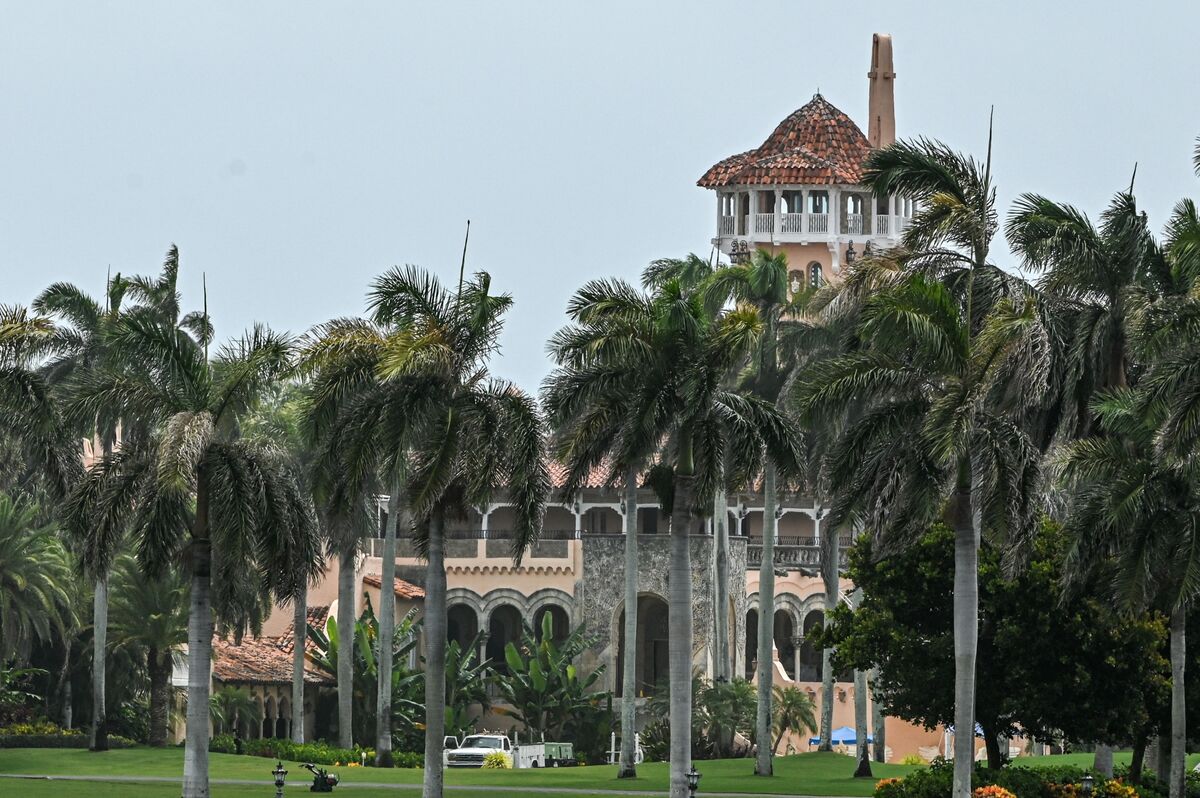
We now know that the reason the Federal Bureau of Investigation searched Donald Trump’s Palm Beach residence last week is because the 45th president is under investigation for pocketing classified documents related to nuclear weapons and possibly violating the Espionage Act. For good measure, he may have also lied to federal officials about the documents and obstructed justice.
Much of the drumbeating that followed news of the FBI search focused on investigators’ motives for executing a search warrant at Mar-a-Lago. That’s largely because Trump seized the public relations high ground in the wake of the search, filling a communications vacuum the Justice Department helped create by not providing more immediate clarity about its investigation.
Trump is not sophisticated or particularly bright, but messaging is one of his superpowers. No sooner had he characterized the FBI search as a politically motivated hit worthy of “broken, Third-World Countries” than his GOP apologists and Fox News enablers went to work repeating the same lies and talking points. Possible FBI malfeasance became a centerpiece of the debate about the search. Even well-intentioned observers stroked their chins quizzically. “Hmm” they allowed, “maybe the FBI has gone off the rails.”
But a few turns of the news cycle and one press briefing from Attorney General Merrick Garland have properly refocused attention on the suspected perpetrator — Trump — and dimmed some of the histrionics aimed at the FBI. Keep worrying about FBI overreach if you’d like, but more pressing answers are needed for why Trump absconded with the documents in the first place.
I think there are three likely reasons Trump wanted to keep all that top-secret paperwork and classified paraphernalia to himself — even if we still don’t know exactly what he had stashed in his safe, closets and socks at Mar-a-Lago.
Reason One seems relatively harmless. Trump is a seven-year-old grown old, and he liked some of the cool doodads you get your hands on as president. He reportedly wanted to keep an Air Force One model displaying a bespoke paint job he had commissioned for the presidential jet and resented restrictions against hanging on to such stuff. Among the disputed documents at Mar-a-Lago was a meteorological map of Hurricane Dorian that he had infamously marked up with a black Sharpie. Who knows why that map was so important to him? Who cares?
The second and third reasons aren’t harmless at all. They’re deeply damaging and troubling.
So, Reason Two: Money. Unfettered greed has motivated Trump his entire life. He didn’t get into the casino business to beautify Atlantic City. He didn’t propose a mega-development on Manhattan’s West Side because it would have made New York more livable. He didn’t start Trump University to educate students, and he didn’t host “The Apprentice” to tutor entrepreneurs. He didn’t originally run for president to revitalize democracy. Money, money, money.
Other graduates of the Trump administration have cashed in in ways that should raise national security concerns. Former White House adviser Jared Kushner (Trump’s son-in-law) and former Treasury Secretary Steven Mnuchin have received billions of dollars from Saudi Arabia to seed their nascent money-management firms. Those deals still look like influence peddling, but to Trump they undoubtedly looked like huge and enviable paydays. It had to occur to him that if hangers-on such as Kushner and Mnuchin could rake in billions because of their proximity to him, he could sell himself — or, possibly, state secrets — for even higher prices.
Recall that Trump’s businesses have been in difficult straits. When Trump left the White House, his operations were saddled with about $1 billion in debt, $900 million of which comes due relatively soon. He personally guaranteed repayment of about $421 million of that debt. And his businesses — concentrated in urban real estate and leisure — were pummeled by the economic downturn that accompanied the Covid-19 pandemic. Trump and his firm, the Trump Organization, also face civil and criminal fraud investigations in New York that could put him out of business.
That’s a lot of financial pressure, especially for someone already prone to be a money-grubber. It should also raise alarms for any rational observer concerned that Trump might have been inspired to use the powers and access to records that his presidency provided to rake in lucre by peddling classified information after he left the White House. Perhaps that won’t prove to be the case — and I hope it doesn’t — but extreme vigilance around that particular problem would be well advised.
Reason Three: Reputational damage. Trump reportedly held on to letters he exchanged with North Korea’s dictator, Kim Jong Un. Perhaps vanity inspired that move because Trump has referred to such correspondence as “love letters.” But what other communications are contained in the documents Trump kept? Anything with Russian President Vladimir Putin or Chinese President Xi Jinping? How about documents pertaining to Trump’s phone calls with Ukrainian President Volodymyr Zelenskiy from that time when Trump was trying to strong-arm Zelenskiy into digging up dirt on his political opponent, Joe Biden. Those communications led to the first of Trump’s two impeachment proceedings.
Again, maybe there’s nothing of this sort, either, in the documents Trump kept. But it’s not unreasonable to worry that his communications with foreign leaders — and anything disreputable or possibly illegal that took place in connection with those — could have been something he felt compelled to hide.
The frenetic pace at which Trump has seeded the ground with lies in the wake of the Mar-a-Lago search certainly suggests that he has something to hide and that he’s worried about the investigation. After all, he has claimed, without even a hint of fact, that the FBI planted evidence at Mar-a-Lago. Trump also claimed that he wasn’t the first president to lift classified information and said former President Barack Obama kept 33 million pages of documents, “much of them classified.” The National Archives controls all of Obama’s papers and swiftly debunked that howler.
Trump and his allies have also asserted that Trump had the power to declassify all of the documents in his possession as president and that he declassified the contested documents held at Mar-a-Lago. No harm, no foul. But as Barbara McQuade, a professor at University of Michigan Law School and a former federal prosecutor, has pointed out, that distinction doesn’t matter.
“Classification is irrelevant,” McQuade noted on Twitter. “Government documents that pertain to the national defense may not be withheld from the government upon request for return. The obstruction charge in the warrant suggests Trump tried to conceal what he had.”
Trump has also flexed his muscles more directly. The New York Times reported that he had an intermediary warn Garland before his press conference last week that people were enraged by the FBI’s search of Mar-a-Lago. Armed Trump supporters have since marched outside the FBI’s offices in Phoenix. One gunman who stormed an FBI office in Cincinnati last Thursday was shot and killed. The federal judge who approved the FBI’s search warrant for Mar-a-Lago has been subjected to antisemitic attacks and threats online. Some of those attacks were also directed at his synagogue.
Sorting out this investigation before the violence escalates further should be a priority for law enforcement, but it has to be sorted out. Soft-peddling an examination of whether a former president stole state secrets and what he wanted to do with them — especially if it involved espionage — because of violence or threats of violence only plays into Trump’s hands.
More From Other Writers at Bloomberg Opinion:
Want more Bloomberg Opinion? Terminal readers head to OPIN <GO>. Web readers click here.
To contact the author of this story:
Timothy L. O'Brien at tobrien46@bloomberg.net
To contact the editor responsible for this story:
Daniel Niemi at dniemi1@bloomberg.net