Monday, March 6, 2017

Rich Asian Millennials Pool Family Fortunes to Build Venture Fund


...they want to fill a gap in the region for the subsequent rounds of funding -- series B, C and D. “We want to play in that space because you get to cherry pick,” he said...

[On real estate]
...Ng recalls his grandfather, Singapore’s richest man when he died in 2010, would always visit a property he was interested in buying with his wife. After driving around the area, they would sit on a bench and observe it from a distance. Then they would return to the same spot after dark.

“He said to us, ‘What you see during the day can look very different at night,’” Ng said....


https://www.bloomberg.com/news/articles/2017-03-05/rich-gen-y-asian-kids-pool-family-fortunes-to-build-venture-fund

Sunday, March 5, 2017

Podcast - (early March 2017) - on Tech Companies, Amazon, Apple, Google, etc.

https://assets.bwbx.io/av/users/iqjWHBFdfxIU/vSoXWj.mQlWE/v2.mp3

Maudlin - on Jobs and Small Business Startups

...Because, at the end of the day, the data shows that net-net, new job creation comes from small business startups. That is, all of the net new job creation comes from small businesses less than five years old.
Well, hooray! We are still creating 450,000 new businesses a year. Well, except. Except that we are losing more enterprises every year than we are creating. And we have been since the beginning of the Great Recession.
Part of the problem, as Tyler Cowen describes in his new book, The Complacent Class, is that Americans have seemingly lost some of their entrepreneurial drive. In the 1980s new startups accounted for some 12–13% of all businesses. Today it’s 7–8%. If we want to create an economy that is a jobs machine, we are going to have to have more business startups. Which means that we have to create a climate in which people feel comfortable in launching risky new ventures.

...large businesses, as a group, are not net creators of new jobs. They absolutely create new jobs at the front door, but at the back door they are ushering out old jobs...

...The jobs of the future are in new companies that have yet to be dreamed up. But they will all have to be found and financed.

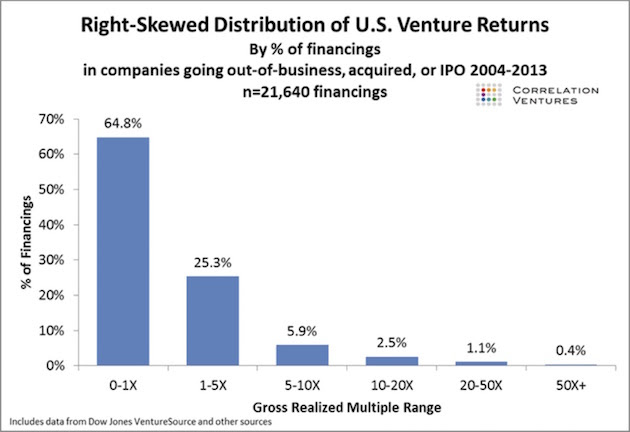
New-business creation is an extraordinarily risky business. Michael Gerber tells us that 80% of all new businesses fail or no longer exist in their original form within the first five years, and 80% of the remaining businesses no longer exist five years after that. The data from seasoned venture capital companies around the country more or less confirms these numbers. Here is a chart that I quickly found:


...And every one of those new ventures and the half a million new businesses started every year requires capital. Every $%^&$&^% one of them. Blood and sweat and tears and lots of money. And that money has to come from somewhere.

There are many politicians who think there is a new-jobs fairy. Just give the government more money, and it can create a “jobs program” that will create those new jobs.

Okay, now I’m going to be the guy who told your kids there is no Santa Claus.

There is no jobs fairy. Just call me Mr. Grinch.

All there is, seriously, is a dream factory where some person wakes up and decides they can create a brand-new future that leads to a better world and coincidentally some income for them. Or maybe the desire for income comes first. But then they have to figure out where to get the startup money. Business plans. Credit cards. Family and friends. If you’re connected and in Silicon Valley, maybe an introduction to Kleiner Perkins. And you’d better be damn good if you want to be one of the 5% they choose to back.

Most new businesses are more mundane than high-tech. Hairdressers, bars and restaurants, dry cleaners, and tons of franchise companies. Seriously, franchises are real businesses. For example, 82% of McDonald’s are owned by franchisees. They make between $500,000 and $1 million in profits per year. Various franchises account for over 8% of US jobs. All of the top 50 franchises are rather mundane local businesses – doughnut shops and hair salons and commercial cleaning outfits. Not exactly high-tech but solid jobs nonetheless. Seriously – go to Entrepreneur magazine’s Top 500 Franchise List if you have nothing else to do. Find me a high-tech, cutting-edge startup on the list that is going to be the next Google or Apple. But are these real businesses? Yes. Long-term moneymaking opportunities? Maybe. But costly to start up? Absolutely...

Problem:

...total US government spending – federal, state, and local – is more than 35% of the US economy, not including the increase in the national debt every year. Private business is less than twice the size of government and has to support all those government expenses....

...the data clearly shows that the more capital there is in a country, the more entrepreneurial capacity there is. And if you tax that capital too heavily, then you’re going to have less entrepreneurial activity. That is substantiated across countries and time in all of the research....

...the explosion of new businesses in China as capital becomes available?...

Please don’t give me this mumbo-jumbo BS about Federal Reserve interest rates and job growth. If you are starting a business, interest rates make damn little difference. You can’t borrow money from traditional sources anyway, except on your credit cards, which probably carry high interest rates. And maybe you can induce friends and a few other people to take less interest than that on their loans to you, which you have to guarantee. The businesses that are helped by lower interest rates are larger businesses that already have access to the credit window at their banks. But all the research – and I mean ALL the research – shows that large businesses are net destroyers of jobs. So maybe lower interest rates help them destroy fewer jobs, but low rates are not helping them create new jobs....

...the Republican leadership understands that cutting taxes and putting more money into the hands of potential entrepreneurs is the way to create jobs. ...

...That’s an entrepreneur. And when you tax them and regulate them and create all sorts of obstacles, you don’t get the new jobs they can create. That’s just a fact, Jack. You can live in your %*&^%*&^ ivory towers and point to data flows, and they don’t mean a thing because the data can tell you whatever you want it to tell you. The reality is, it all happens down on the front lines, where entrepreneurs wake up every morning trying to figure out how to make their businesses bigger, better, badder, meaner, leaner, faster. And they try to motivate their (often few) employees to sign on to the vision, for a paycheck – and, in a few cases, a piece of the future....

...In the words of Barry Switzer, one of the greatest football coaches of all time, “There’s only one most important thing. Don’t fumble the @%#$@# ball.” In 2017, the Republicans have the ball. Here’s hoping they don’t fumble it....

Future

...the storms that we all know are coming as the world struggles to figure out how to deal with the massive amounts of debt and government obligations that are building up. Maybe not this year, but at some point there has to be a great reset,..


http://www.mauldineconomics.com/frontlinethoughts/tax-reform-the-good-the-bad-and-the-really-ugly-part-four

Saturday, March 4, 2017

Tax Reform: The Good, the Bad, and the Really Ugly—Part Four (Maudlin)

http://www.mauldineconomics.com/frontlinethoughts/tax-reform-the-good-the-bad-and-the-really-ugly-part-four

...Let me pull a few random quotes from Nicholas Eberstadt’s powerful book Men Without Work. These are just a few of the almost 40 pages that I copied and made notes on from his 200-page book. I could literally write a whole letter just focusing on what I think are important quotes.
The work rate has improved since 2014, but it would be unwise to exaggerate that turnaround. As of early 2016, our adult work rate was still at its lowest level in three decades. If our nation’s work rate today were back to its start-of-the-century highs, approximately 10 million more Americans would currently have paying jobs.

Here, then, is the underlying contradiction of economic life in America’s second Gilded Age: A period of what might at best be described as indifferent economic growth has somehow produced markedly more wealth for its wealth-holders and markedly less work for its workers. This paradox may help explain a number of otherwise perplexing features of our time, such as the steep drop in popular satisfaction with the direction of the country, the increasing attraction of extremist voices in electoral politics, and why overwhelming majorities continue to tell public opinion pollsters, year after year, that our ever-richer America is still stuck in a recession….

All of these assessments draw upon data on labor market dynamics: job openings, new hires, “quit ratios,” unemployment filings and the like. And all those data are informative—as far as they go. But they miss also something, a big something: the deterioration of work rates for American men…

Between 1948 and 2015, the work rate for U.S. men twenty and older fell from 85.8 percent to 68.2 percent. Thus the proportion of American men twenty and older without paid work more than doubled, from 14 percent to almost 32 percent. Granted, the work rate for adult men in 2015 was over a percentage point higher than 2010 (its all-time low). But purportedly “near full employment” conditions notwithstanding, the work rate for the twenty-plus male was more than a fifth lower in 2015 than in 1948.

....

The research shows that technology has net-net created far more jobs than it has destroyed. You can see this outcome in a wide variety of research over the years, but a recent study by Deloitte (as reported in the Guardian), which drew on data going back to 1871 in England and Wales, found that technology has been a job-creating machine. Part of that is because technology increases people’s spending power, which creates a surge in the demand for hairdressers, bar staff, etc.

Going back over past jobs figures paints a more balanced picture, say authors Ian Stewart, Debapratim De and Alex Cole.

“The dominant trend is of contracting employment in agriculture and manufacturing being more than offset by rapid growth in the caring, creative, technology and business services sectors,” they write.

5 Ways ‘Passive’ Investing Is Actually Quite Active - Bloomberg

https://www.bloomberg.com/view/articles/2017-03-03/5-ways-passive-investing-is-actually-quite-active

  1. Index Construction
  2. Portfolio Management   You can tell how well passive managers play this game by using an underrated metric called “tracking difference,” which basically measures how far off an index fund or ETF is from its index’s return. 
  3. Usage in Portfolios
  4. Engagement With Companies
  5. Right now, index funds and ETFs via Vanguard and BlackRock own 12 percent of the stock market. (This number is expected to grow quickly, with 75 cents of every new dollar invested in the U.S. going into these two companies’ index-based products.) 
    1. Above-Average Returns

Thursday, March 2, 2017

Watch U.S. Oil Drilling Collapse—and Rise Again - Bloomberg


... Raw rig counts are losing their predictive power. The drilling industry is increasingly automated, and wells are pumping oil faster. Gone are the abundant high-paying jobs in pop-up oil towns filled with roughnecks. The U.S. now produces 9 million barrels a day; when the shale boom first crossed that threshold in 2014, more than twice as many rigs were actively drilling.

https://www.bloomberg.com/graphics/2017-oil-rigs/

Wednesday, March 1, 2017

A Delivery Man Just Became One of the Richest People in China - Bloomberg

A Delivery Man Just Became One of the Richest People in China - Bloomberg


...Government support for the industry has also included encouraging Chinese package delivery companies to seek capital through equity markets—and approving their bids to raise money quickly, through backdoor listings that involve the companies taking over others, typically in unrelated fields, that are already publicly traded. So-called reverse mergers take a year or less to result in access to equity, while an IPO in China may take as long as three years, according to Sinolink’s Su. China’s current list of IPO seekers has 621 companies awaiting approval by the China Securities Regulatory.


...Now the courier operates a fleet of 36 cargo aircraft and about 15,000 vehicles. It reported revenue of 48.1 billion yuan in 2015, the highest among its domestic peers, according to its listing prospectus. It intends to build a cargo airport in the central Chinese province of Hubei, the prospectus said.