Tuesday, January 12, 2021

What Do Wall Street Leaders Think Is the Next Big Risk? - Bloomberg

What Do Wall Street Leaders Think Is the Next Big Risk? - Bloomberg

Wall Street Visionaries Provide Chilling Views on Next Big Risk

We asked three executives who’ve spent their careers on the cutting edge of the financial industry what they see coming in 5 to 10 years. Here are their answers.


By Sonali Basak

January 12, 2021, 5:00 AM EST


Few predicted—and most were unprepared for—the enormous challenges that have kicked off this decade: pandemic, economic collapse, social unrest, and political divisions around the world. Yet it’s the job of a Wall Street executive to factor in all the unknowns. So Bloomberg Markets asked three of the wisest and most visionary people in the industry about their worries for the next 5 to 10 years: R. Martin Chavez, who helped build Goldman Sachs Group Inc.’s trading and technology departments before he became a senior director in 2019; Eileen Murray, a Morgan Stanley veteran who was co-chief executive officer at Bridgewater Associates LP before stepping down in March 2020; and David Siegel, co-founder and co-chairman of quant trading giant Two Sigma Investments LLC. Their comments have been edited for length and clarity.


Safeguarding Systems

R. MARTIN CHAVEZ

Senior director and former global head of securities, Goldman Sachs


If I lie awake thinking about bad things that can happen, my concerns—and this may say more about me than anything else—are almost all about cybersecurity. Can we actually rely on, for instance, the integrity of core systems?


Here’s a scenario that is not contemplated in CCAR [the Federal Reserve’s Comprehensive Capital Analysis and Review, an annual assessment of the largest U.S. banks]: What about the Fedwire? The Fedwire is the definitive central book that says, “Who’s the beneficial owner of which Treasury security?” We rely intensely on that infrastructure. And of course, the Fed has done a very great deal to have hot backups and warm backups and cold backups. I don’t know that we’re putting enough time and energy into modeling what a disruption of banking systems—core banking systems, payment systems such as the Fedwire—what that would do to our economy.


You remember from a few years back that some hackers managed to get a hold of the Swift [Society for Worldwide Interbank Financial Telecommunication] credentials of Bangladesh Bank, the central bank of Bangladesh, and caused several tens of millions of dollars to disappear from Bangladesh Bank’s master account at the Federal Reserve Bank of New York. Some of the money was recovered, but some of it seems to have disappeared into casinos in Macau—walked out the door and was never recovered. In this case it was not a failure of the Federal Reserve. Someone managed to get access to the Swift credentials of a bank that had an account at the Federal Reserve, and they drained that bank’s master account.


Next Big Risk

The whole point of being a risk manager is not to say that something’s going to happen and to be an alarmist, it’s just to open your mind to a lot of possibilities of things that could happen—and then get yourself comfortable that they’re really unlikely. So I just don’t know about all of the security arrangements of the Federal Reserve, for instance, or of the ECB [European Central Bank]. I have confidence that they take these matters with extreme seriousness, but I personally don’t know exactly what they are doing, what kinds of technologies they’re using, to safeguard the system.


Almost all U.S. Treasuries do not exist in the form of a paper certificate—over 99.9% of them exist purely in electronic form. And Treasuries are the beating heart of the global financial system. Every country has its inventory of U.S. Treasuries. Treasuries are used as collateral for everything.


“I worry more about nonfinancial companies than I do about financial companies”


And yet, if you ponder that they exist entirely in electronic form, you’ve got to really start worrying about that electronic form. I am actually less worried that [these systems] could be hacked and simply halted. The thing that I think worries me more is, could it systematically be corrupted by a hacker? So instead of having confidence in who is the beneficial owner of every Treasury, [you might wonder] in whose possession is that Treasury at every moment in time? Because that’s the core of the financial system: moving Treasuries around. But when you think about it, the Treasuries are electronic—they’re not actually being moved in physical space; there’s just a computer somewhere that’s keeping track of who owns them. And if someone could get into that record and cause us to lose confidence in who owns the Treasuries, that would be, I mean—it’s so hard to even think about that outcome—it would be so extreme and so dire.


However, I worry more about nonfinancial companies than I do about financial companies. If you looked at the pandemic, there was very little concern about the integrity and stability of banks. Think of how startling that is, right? Compare that to the financial crisis, which was all about concerns about participants in the financial ecosystem. In the current crisis, the concern has been about everybody except banks, and I would say an important reason for that is CCAR.


Should there be a CCAR equivalent for systemically important nonbanks? As we discovered in the pandemic, there’s a lot of systemically important companies. It suddenly became obvious to everybody. Without Amazon or Google or our internet service provider, our problems would become even greater. And so, do we want to have some kind of framework so that we can have confidence in nonfinancial companies in a crisis?


There’s been a lot of concern over the past few years about artificial intelligence. Will some AI take over, and then we become the AI’s pets? Well, I’m actually more worried about something that I think has already happened.


We already have massive AIs in the form of these tech companies. Their data centers are running software on those millions of computers, and collectively they are artificial intelligences. And they’re artificial intelligences that are systematically exploiting weaknesses in human psychology: our tribalism, our gullibility, or wanting to be told what to believe, our wanting to be liked, our wanting to be told that we’re right. And they’re exploiting it to the end of maximizing advertising revenue. So, yes, I think we have to ask ourselves: Should we even allow this model of targeted digital ads? I worry a lot less about subscription services. If I’m paying someone a subscription like Netflix, their job is to keep me happy so I keep paying that subscription. But you know that old saying: “If you are not paying for some product or service, then you are the product or service.” So, yeah, I spend a lot of nights lying awake thinking about the extent to which we have become the product of artificial intelligences that are selling our attention and our behavior to advertisers. I think that core business model is extremely problematic in a way that untrammeled, undercapitalized trading and inventory of risk was a problem that was part of the financial crisis.


Mass Unemployment

EILEEN MURRAY

Former co-CEO Bridgewater Associates


I think the next pandemic that’s coming is the displacement of the workforce [that’s] not being trained to participate in the economy. Dealing with that will take a lot more than a vaccine. The unskilled worker is the next pandemic.


Let me just step back. First of all, I think that it’s pretty clear if you have high degrees of unemployment, there are basic economic impacts that are not good for the nation. It puts an incredible strain on the economy. It usually only gets addressed through higher taxes on a smaller and smaller tax base. It increases the gaps between the haves and have-nots, which historically has caused more social unrest if it goes on for a period of time. We saw high levels of unemployment like in the Depression create hopelessness and despair in individuals, in families, and their communities.


I think [unemployment] happens as quickly as automation displaces people from work without concurrently retraining them and retooling them for other types of work. Does that make sense?


Look at the amount of money the U.S. spends on education per capita, and look at where it places in terms of education among developed countries. There’s a mismatch there. Throughout history, education has proven to be the vaccine for poverty and for the gaps between the haves and have-nots.


What I’m seeing is a growing gap between the haves and have-nots. The rich are getting richer, the poor are getting poorer, and we’re losing the middle class. To the extent that you have rising unemployment, you have people who can buy fewer goods and services, and you also have a need for the government to increase the tax base, including corporate taxes. The better way is for business, government, and educators to get together and say, a) “Do we all agree there’s a looming problem ahead of us?” and b) “What are the things that we can jointly do to start working on that problem?”


I’ve been talking about the issue for the last 10 years. McKinsey did a 2013 study and found that up to $9 trillion in global wage cost can be eliminated by automating a wide range of knowledge-intensive tasks such as analyzing customer credit ratings and providing financial advice. That’s 2013. I don’t know what the numbers would be today. There was also a study by the Oxford Martin program on technology and employment: Only 0.5% of the U.S. workforce is employed in industries [associated with new technologies] today that didn’t exist at the turn of the century. And it’s not just that these people aren’t a significant part of these new industries—it might be the nature of the industry—but we need to find ways of getting people more involved and better trained. And I don’t mean just college training. It might be training in different types of work such as working on rebuilding infrastructure. I think it’s a function of government, education, and business getting together.


In other words, this problem isn’t going to be solved by a vaccine. It’s not going to be solved by more military force or more security. It’s not going to be solved by those kind of things that happen more quickly. It’s going to be solved by retraining or retooling.


“When you take away from people the hope to realize their potential, that is the epitome of despair”


Let me give you an example. Companies may have to put up capital for future litigation costs. They might have to put up capital for certain regulatory things, so should regulators give companies that retrain their people a break vs. companies that don’t retrain and retool?


There’s been a lot of college graduates. And a lot of them didn’t find jobs. Did we produce more college graduates than the economy needed? But I also know that we don’t have enough electricians; we don’t have enough plumbers. Are there other skills beyond a four-year college diploma or an MBA that could be alternative ways of training or developing people for the future economy?


I don’t think companies will keep unproductive people around for very long. Here’s what I think is hopeless: If you tell someone this is your life for the next 40 years, and you’ll be doing the same thing over and over again, when you take away from people the hope to realize their potential, that is the epitome of despair.


Is this the best we can do societally? Is this the world we’re going to leave for our children?


Devaluing Humans

DAVID SIEGEL

Co-founder and co-chairman Two Sigma Investments


One thing that I worry about, which may not necessarily be something that people talk about all the time—remember, I’m a tech guy—is that we may be building a world that is not particularly designed for humans.


Henry Ford talked about it long ago. He wanted to produce cars, but he wanted to make sure that the people producing the cars could earn enough money that they could buy the cars. And you get this wonderful effect where the growth in economic output produces good jobs, which then will help grow the economic output. It becomes a virtuous cycle.


What we’re doing today is finding more and more ways to essentially reduce the need to have humans involved with work. So much of the investment in business in America is to essentially automate away human labor or, even more curiously, to devalue human labor.


The nature of work is changing. For some people it’s getting a lot better. But for probably the majority of people, it’s not really getting better. If you can’t fix this problem, what could occur is that we end up with this sort of barbell economy where a lot of people aren’t really doing all that well. Not only is that just not a good thing, but also they’ll have less money to spend to make the economy get bigger, so the Henry Ford thing won’t occur. I think this is being overlooked. And it’s happening kind of slowly.


I am not at all concerned that there’ll be a shortage of work. There will be plenty of things for people to do. The problem is, they may be things that we don’t want to pay much money for.


Are we truly building a better world for ourselves? Or are we trying to essentially optimize some number like GDP, which in the end doesn’t have all that much to do with whether or not we’re happy and fulfilled and it’s a good stable society? So we’re having more and more focus just purely on automating stuff away, trying to make things more efficient, that may not actually make your life and my life and everyone else’s lives feel better. It may not be like a human-centered society.


I don’t think people are reflecting enough, in America anyway, as to whether or not this is precisely what we want. It’s different in other countries. In Japan, for example, I think people have put more emphasis on upgrading experiences because they understand that when you go out—walking down the street, going into stores, and all that—if you make it appealing, people not only will want to go to your store, but it’s an experience, you enjoy it. So what will the modern experiences be? Are we going to all be sitting at home, wearing VR goggles, and clicking away all the time?


“Do you really care about GDP? Is that how you’re gauging the quality of your life?”


Social networks like Facebook, people talk about all the problems, but you know one thing that it does is it makes socializing very efficient. So you can have your 100 friends or 500 friends, and you don’t have to waste time calling people up telling them what happened. You go click, click, click, and then everyone knows about your life. It’s the most efficient way to socialize, right? Something doesn’t sound right. You know that. Do you really want these levels of efficiency?


I’m not nearly the first one to say this, but at least at a very high level, GDP is the thing everyone looks at. And, you know, quite frankly, I’m not sure that that matters all that much. Because it’s literally such a crude number. Do you really care about GDP? Is that how you’re gauging the quality of your life? No? OK. We don’t spend very much time thinking about the quality of life more broadly. You could in some sense create an ever-growing GDP but have most people saying this is pretty bad. We could end up with a lot of unhappy people. Maybe we’re there already.


A lot of people talk about, is AI dangerous? Some people have been out there saying it’s more dangerous than nuclear weapons. I think that that’s very silly. AI is a very useful tool. But the question is, how do you use it?


Basak covers finance in New York.


The U.S. Should Invest in the Jobs of the Future - Bloomberg

The U.S. Should Invest in the Jobs of the Future - Bloomberg

The U.S. Should Invest in the Jobs of the Future

The economy is failing too many people.


By Editorial Board

January 12, 2021, 8:00 AM EST


After President-elect Joe Biden takes office this month, he’ll have to grapple with a big issue that helped bring his predecessor, Donald Trump, to power: For far too many Americans, the U.S. economy isn’t working. An educated, largely coastal elite is pulling ever farther ahead, but millions of others across the nation are struggling and deeply concerned about the future.


The challenge is to unlock the potential of the people and places left behind. This will require a level and quality of investment that the nation hasn’t seen for many years.


Even before the pandemic hit, the U.S. economy was in much worse shape than the low unemployment rate suggested. Almost all the income gains of the past several decades had gone to the wealthiest tenth of the population, leaving the bottom half hardly better off. Even as people in coastal growth centers such as New York and San Francisco lamented congestion and sky-high rents, deindustrialization had turned large swaths of the country’s heartland into no-opportunity zones. The productivity boom of the 1990s had long since petered out. People of color and women had made great progress, but still faced obstacles in achieving all they could. The coronavirus crisis deepened the malaise, taking a disproportionate toll on minorities and the poor.


How can America come back? Fairer taxes and a stronger social safety net are certainly part of the answer, but by themselves won’t be enough. What’s needed is the kind of growth that raises living standards more broadly. This can’t come from rejecting international trade or trying to revive obsolete industries. Rather, the country needs to make an ambitious investment in its future — renewing its global technological leadership, creating well-paid jobs and tapping the talents of all its people.


This will require more public spending, but with interest rates on government borrowing at multi-decade lows, the financial conditions are as conducive as they’ll ever be. Done right, the investment will more than pay for itself. Here are some priorities:


► Revive the heartland. Fundamental scientific research is among the best investments a government can make. It produced Silicon Valley and the biotech industry. But public investment in basic science is running far below the levels that laid the foundation for those successes. So one priority should be a major R&D program with the goal of creating new hubs of growth in parts of the country that need it most. It should aim for breakthroughs in green energy, public health and agriculture, with support for early-stage financing and the advanced manufacturing capacity needed to turn discoveries into new industries.


Programs of this kind do face pitfalls, and the record of governments in pressing such initiatives is mixed. It will be important to learn from past mistakes and spend public money wisely. But economists have identified dozens of potential candidates with a promising mix of characteristics, such as high-quality universities, low housing costs and easy commutes.


As always, competition will help: Preference should go to cities that offer the best development plans, with the technical education, transportation, amenities and other services required to ensure benefits are widely shared. Over 10 years a plausible outlay might be between $100 billion to $200 billion. There’d be failures — but with careful execution, the gains should greatly outweigh the losses. 


► Upgrade infrastructure. To succeed, growth centers need to be connected to the rest of the country, both physically and virtually. Yet America’s roads, bridges, airports and broadband internet service are notoriously inadequate, undermining living standards and productivity nationwide. Fixing this will be expensive — say about $1 trillion over 10 years.


Spending the money wisely requires collecting data to understand how transportation routes are used, what mix of modes would best serve people’s needs, and where investments in greener public-transit options such as high-speed rail would make the most sense. New projects are only part of what’s required. In many cases, spending on adequate maintenance of existing infrastructure would be at least as productive.


One key goal should be extending high-speed broadband to the more than 150 million people who, by one estimate, still lack it — a task that can be accomplished quickly by auctioning federal subsidies to private companies. Access is particularly important for rural communities, which could become attractive bases for remote work.


► Break down barriers to prosperity. Too many Americans face obstacles to full participation in the economy. Some can’t physically move to seek opportunity, because of zoning rules designed to keep them out, and because benefits such as housing subsidies frequently aren’t portable. Some can’t find work because of needlessly burdensome licensing requirements or non-compete clauses in their contracts. Some, particularly women, lack access to the affordable child care that would help them build their careers. Others are trapped in neighborhoods where it’s hard to be healthy, get educated, and stay out of trouble. 


Real progress in any of these areas won’t be easy, but the effort should be made. Biden has supported parts of this agenda, and doubtless agrees with its ambition. Shortly he’ll be in a position to build support for such polices and put them into effect. The country as a whole stands to gain.


To contact the senior editor responsible for Bloomberg Opinion’s editorials: David Shipley at davidshipley@bloomberg.net .


Monday, January 11, 2021

The Constitution's Option for Impeachment After a President Leaves Office

The Constitution's Option for Impeachment After a President Leaves Office

This is why John Quincy Adams proclaimed on the floor of the House that, “I hold myself, so long as I have the breath of life in my body, amenable to impeachment by this House for everything I did during the time I held any public office.” (Michael J. Gerhardt, The Federal Impeachment Process:  A Constitutional and Historical Analyses 80 (2d edition 2000) (citation omitted))  Adams’s suggestion was that any impeachable official remained subject to that process well after they left office, not just presidents but those who abused power while in office.

Saturday, January 9, 2021

First Thoughts on a National Tragedy | Geopolitical Futures

First Thoughts on a National Tragedy | Geopolitical Futures

http://email.mauldineconomics.com/ss/c/VAnio6QOMjjuyZBmiauY6lF1Ya4UvWVouzYy-R2CG4hRwaPZ_4CcTXRSkLkWU2_aQtgOofeSf3QZAYBGW3ebh2bLJdxKdNG6InQWyNWc59q9wLwLm2gS7RJMtKv6KgwR1HsKWjTDlZPEErBT1Ks0pYzbTRITLoUz8MPazxxZN5yNglvi4nares4q3vJlXNxuqB_E6_mwY7Q-rcwMy4zOaBobIHPg8DDfq-emhgKkxw7clxNzN-MFuj28aYrC1-9TKkc-C4AZ-akUhBPVnJIAwB0XEMC6KWP-Lhg_Hr2PNO2NRLOxCE7kR_-Q6UF9otl-xAcc1XyzhwGp9XMoPePaV89S6_N-F-KAK4f1FlhWxX__XZitOYvkeXucxsxCr7NfcAm8rOq5rQXgvFMRv-x5I07ZGAps8XFTOuSY_VsRvxmsh9-tgEMdKKq6FvvxSDtrv4g6OSj65PFjFREZlBn-5Kj6CefHoQQ7Tfepw5-OosOrIno5_t61AH-deVp0_pMn/38f/KEm8kglzRg2H-egbPGkPUg/h6/rZC1a8fAmcSwKPSwJSMx9P0XYouhs48kx6TWKBLwNj4

First Thoughts on a National Tragedy

By George Friedman -January 7, 2021


A physician is taught to avoid emotional involvement with patients. If he suffers with them, the pain will break him and his judgement will be impaired. He must be clinical and disinterested in order to understand what he is seeing. Avoiding emotions is necessary, but it exacts an extraordinary toll of either pain or an insensitivity to pain. Striving to understand demands distance, but that distance inevitably breaks.


The task I have set myself is to try to understand the way the world works, and to do that, to some extent, I must not allow myself to participate in it. The world is filled with opinions about what ought to be, and the cacophony of self-certainty is a luxury from which I must imperfectly try to remove myself. As Wednesday unfolded, the opinions were overwhelming. I am a citizen of the United States, and it is at times impossible to keep my distance, much as it would be for a physician to treat his own child.


My job is to say something, but what can you say about the unthinkable? How can you speak when you are grieving? The capital of our country was invaded by a mob, some carrying weapons, who had been encouraged to do so by the president. Nothing that was said for or against Donald Trump was sufficient for the moment, and all those who claimed to have foreseen this or claimed that what we saw did not happen are merely continuing the routine chatter of political discourse. I am supposed to be able to explain what has happened, but the ordinary criticism or defense of Trump doesn’t comprehend the moment, and in any case it misses the point. It is not Trump but we ourselves who are to blame, and what we have become toward each other that has somehow been corrupted. None of this could have happened without the rancor tacitly or deliberately embraced.


I am not able to think analytically about this, nor can I pretend that my writing predicted this. I must approach this as what I am: a citizen of a nation that gave me sanctuary, to which I owe my life and which I tried to serve as best I could. I have traveled the world and seen many acts of political rage and cruelty. I have seen coups. This may have been a blundering one, but it was a coup nonetheless, carried out with the intent to change the outcome of an election. It happened in my country, and in its capital city, and in its Capitol building. That moment made us simply another country, and not the city on a hill, shedding light on the world.


I was forced into silence by grief. When something enchanting dies, it calls for a moment of silence over what was lost. Every word uttered demeans the moment. And so I was silent. Now I speak, but what is there to say? The light of the shining city on a hill must be relit, and to relight it we must begin by willing ourselves to friendship and to refuse to despise each other regardless of disagreement. That is the start. I don’t know if we have the will or the strength to do it.


This is all opinion, not carefully thought-out analysis. And much of it is cliche. But cliches carry some truth. I have tried to understand, but now I am reduced to grief. Others will say they told me so, but then they have said so much that they must at times be right.


We did not lose our country yesterday, but we received a warning that our country is in danger. And it is most in danger, I think, from the spirit of self-righteousness that has gripped our nation. Each of us seems to hold our views as unassailable. Each of us regards other views as monstrous. From this cauldron only poison will be brewed.


I have spoken for myself here, not for my method. For the moment I don’t care for the method, or for the understanding. I long for a lost world in which reasonable people could disagree over politics and still be friends. Donald Trump did not rip friendships apart. We did that to ourselves.


There is no wisdom or genius in what I have said. For now, it is what it is. I will seek to return to ironic distance soon. But my country is in danger, and now is not the time for distance nor the endless chatter of opinions passionately repeated.


I love this country. It is time for its citizens to get a grip.


Bring the Insurrectionists to Justice - WSJ

http://email.mauldineconomics.com/ss/c/HQVUN4swEVAUedFhk8hStDSnc8gHAr-IQCS1jIVebgpfoYO0IGszd_C3RlYi-AH_cxeoyorjkiQ-GuvQAyCSTisN7b1XU7NKwqZTenBGR6Krg80odVJ1fhL4YpV8zk3cYveQ-fCSJORgsp6_3GEOHQ/38f/KEm8kglzRg2H-egbPGkPUg/h5/PE8jb5FER9vTk-Wg45YFJUOSX-uGunhMsT72XzTyo98

Bring the Insurrectionists to Justice

The politicians who egged them on should also be made to pay a heavy price.


By Peggy Noonan

Jan. 7, 2021 7:19 pm ET


https://images.wsj.net/im-282322?width=620&size=1.5

A rioter carries a House podium at the U.S. Capitol, Jan. 6.

PHOTO: WIN MCNAMEE/GETTY IMAGES


How do we deal with all that has happened?


We remember who we are. We are a great nation and a strong one; we have, since our beginning, been a miracle in the political history of man. We have brought much good. We are also in trouble, no point not admitting it.


We regain our confidence. We’ve got through trouble before. We love this place and will keep it. We have a Constitution that’s gotten us this far and will get us further.


OPINION: POTOMAC WATCH

Trump's Push to Overturn the Electoral College


We lower the boom. No civilized country can accept or allow what we saw Wednesday with the violent assault on the U.S. Capitol. This was an attack on democracy itself. That is not just a phrase. Rule by the people relies on adherence to law and process. The assault and siege was an attempt to stop the work of democracy by halting the peaceful transfer of presidential power, our crowning glory for more than two centuries.


This was a sin against history.


When something like this happens it tends to be repeated. It is our job to make sure it is not.


And so we should come down like a hammer on all those responsible, moving with brute dispatch against members of the mob and their instigators.


On the rioters: Find them, drag them out of their basements, and bring them to justice. Use all resources, whatever it takes, with focus and speed. We have pictures of half of them; they like to pose. They larked about taking selfies and smiling unashamed smiles as one strolled out with a House podium. They were so arrogant they were quoted by name in news reports. It is our good luck they are idiots. Capitalize on that luck.


Throw the book at them. Make it a book of commentaries on the Constitution. Throw it hard.


They have shamed and embarrassed their country in the eyes of the world, which is not only a painful fact but a dangerous one. The world, and the young—all of us—need to see them pay the price.


Now to the devil and his apprentices.


As for the chief instigator, the president of the United States, he should be removed from office by the 25th Amendment or impeachment, whichever is faster. This, with only a week and a half to go, would be a most extraordinary action, but this has been an extraordinary time. Mike Pence is a normal American political figure; he will not have to mount a new government; he appears to be sane; he will in this brief, strange interlude do fine.


The president should be removed for reasons of justice—he urged a crowd to march on Congress, and, when it turned violent, had to be dragged into telling them, equivocally, to go home—and prudence. Mitt Romney had it exactly right: “What happened here . . . was an insurrection, incited by the president of the United States.” As for prudence, Mr. Trump is a sick, bad man and therefore, as president, a dangerous one. He has grown casually bloody-minded, nattering on about force and denouncing even his own vice president as a coward for not supporting unconstitutional measures. No one seems to be certain how Mr. Trump spends his days. He doesn’t bother to do his job. The White House is in meltdown. The only thing that captures his interest is the fact that he lost, which fills him with thoughts of vengeance.


Removing him would go some distance to restoring our reputation, reinforcing our standards, and clarifying constitutional boundaries for future presidents who might need it.


As for his appointees and staff, the garbage they talk to rationalize their staying is no longer acceptable to anyone. “But my career.” Your career, in the great scheme of things, is nothing. “But my future in politics.” Your future, even if your wildest schemes are fulfilled, is a footnote to a footnote. There are ways to be a footnote honorably. “But my kids.” When they are 20 they will read the history. You want them proud of your role, not petitioning the court for a name change.


It was honorable to arrive with high hopes and idealistic commitments. It is not honorable to stay.


As for the other instigators, a side note.


True conservatives tend to have a particular understanding of the fragility of things. They understand that every human institution is, in its way, built on sand. It’s all so frail. They see how thin the veil is between civilization and chaos, and understand that we have to go through every day, each in our way, trying to make the veil thicker. And so we value the things in the phrase that others use to disparage us, “law and order.” Yes, always, the rule of law, and order so that the people of a great nation can move freely on the streets and do their work and pursue their lives.


To the devil’s apprentices, Sens. Josh Hawley and Ted Cruz. They are clever men, highly educated, well-credentialed, endlessly articulate. They see themselves as leading conservative lights, but in this drama they have proved themselves punks practicing punk politics. They are like people who know the value of nothing, who see no frailty around them, who inherited a great deal—an estate built by the work and wealth of others—and feel no responsibility for maintaining the foundation because pop gave them a strong house, right? They are careless inheritors of a nation, an institution, a party that previous generations built at some cost.


They backed a lie and held out the chimera of some possible Trump victory that couldn’t happen, and hid behind the pretense that they were just trying to be fair to all parties and investigate any suspicions of vote fraud, when what they were really doing was playing—coolly, with lawyerly sophistication—not to the base but to the sickness within the base. They should have stood up and told the truth, that democracy moves forward, that the election was imperfect as all elections are, and more so because of the pandemic rules, which need to be changed, but the fact is the voters of America chose Biden-Harris, not Trump-Pence.


Here’s to you, boys. Did you see the broken glass, the crowd roaming the halls like vandals in late Rome, the staff cowering in locked closets and barricading offices? Look on your mighty works and despair.


The price they will pay is up to their states. But the reputational cost should be harsh and high.


Again, on the president: There have been leaders before who, facing imminent downfall, decide to tear everything down with them. They want to go out surrounded by flames. Hitler, at the end, wanted to blow up Germany, its buildings and bridges. His people had let him down. Now he hated them. They must suffer.


I have resisted Nazi comparisons for five years, for the most part easily. But that is like what is happening here, the same kind of spirit, as the president departs, as he angrily channel-surfs in his bunker.


He is a bad man and not a stable one and he is dangerous. America is not safe in his hands.


It is not too late. Removal of the president would be the prudent move, not the wild one. Get rid of him. Now.


About this article

Declarations

“Declarations” seeks the truth and then tries to state that truth. The column is published online every Thursday evening and aims to give clarity and humor where appropriate. It is isn’t overtly ideological and asks the reader to be open to different considerations.


She was awarded the Pulitzer Prize for Commentary in 2017.  A political analyst for NBC News, she is the author of nine books on American politics, history and culture, from her most recent, “The Time of Our Lives,” to her first, “What I Saw at the Revolution.” She is one of ten historians and writers who contributed essays on the American presidency for the book, “Character Above All.” Noonan was a special assistant and speechwriter for President Ronald Reagan. In 2010 she was given the Award for Media Excellence by the living recipients of the Congressional Medal of Honor; the following year she was chosen as Columnist of the Year by The Week. She has been a fellow at Harvard University’s Institute of Politics, and has taught in the history department at Yale University.


Before entering the Reagan White House, Noonan was a producer and writer at CBS News in New York, and an adjunct professor of Journalism at New York University. She was born in Brooklyn, New York and grew up there, in Massapequa Park, Long Island, and in Rutherford, New Jersey. She is a graduate of Fairleigh Dickinson University in Rutherford. She lives in New York City. In November, 2016 she was named one of the city's Literary Lions by the New York Public Library.


Trump’s Rebellion Against Reality - The Dispatch

Trump’s Rebellion Against Reality - The Dispatch

Trump’s Rebellion Against Reality

What the riot in the Capitol reveals.

Yuval Levin


The United States Capitol Building opened its doors in November of 1800 to house the very same institution it still houses today—the bicameral U.S. Congress created by our Constitution. No other advanced society can claim that level of political stability over the course of that 220-year period. The arrangement of powers in even the exceptionally steady British regime has gone through dramatic transformations unlike anything we have experienced in America over this time, and most other relatively stable societies (like the nations of Western Europe, Russia, China, Japan, and others) have gone through several fundamental changes of government through conquest, revolution, or political upheaval.


We Americans sometimes still think of ourselves as a young nation, but our political institutions are among the most established in the world. We are stable. And to me the Capitol, with its majestic dome and marble columns, has always seemed somehow to speak of our stability.


But what’s required for political stability? The answer offered by our Constitution is something like the capacity for keeping our balance in the face of changing circumstances. Its way of doing this can sometimes seem mechanical. Our system of government creates an interlocking array of institutions and powers that takes some of the foibles and limits of human nature for granted, sets ambition to counteract ambition, and seeks to avoid dangerous excesses in any direction. As James Madison put it in one particularly Machiavellian passage of Federalist 51, the aim is something like a “policy of supplying, by opposite and rival interests, the defect of better motives.”


But that is hardly the end of the story, as Madison himself soon made clear. “As there is a degree of depravity in mankind which requires a certain degree of circumspection and distrust,” he wrote in Federalist 55, “so there are other qualities in human nature which justify a certain portion of esteem and confidence. Republican government presupposes the existence of these qualities in a higher degree than any other form.”


So although our system of government knows people are imperfect, it still has high expectations of all of us and will not work if those aren’t met. The nature of those expectations gestures toward the republican virtue that the framers took to be essential in both citizens and leaders. And it might be summarized by another Madisonian term—the deceptively capacious word “responsibility.”


As Madison employs the term (and his uses of it are actually the first that the Oxford English Dictionary can find anywhere in print), it describes a mix of obligation and responsiveness. The responsible leader takes ownership of his actions and duties and takes it upon himself to act in response to events. The responsible citizen understands that the republic is at some level his to maintain through both action and restraint.


I couldn’t help but think about this one-word summary of civic virtue all day Wednesday, as our president incited acts of insurrection and a mob broke into the Capitol to disrupt Congress’s counting of electoral votes.


The riot itself is no threat to the stability of our republic. The Capitol Building has seen more than its share of violence and trouble over the years. The British famously set parts of it on fire in the War of 1812. It faced intense crowds of rioters several times in the 19th century, and many times in the 20th. Puerto Rican nationalists fired guns from the House gallery in 1954, injuring several members. Vietnam War protesters set off a bomb on the Senate side in 1971.


In July of 1998, while I was working in the building as a young staffer myself, a gunman made it past the security checkpoint at the entrance and tried to rush the office of House Majority Whip Tom DeLay. The Capitol Police managed to stop him before he reached his target, but not before he killed two courageous officers—Jacob Chestnut and John Gibson. The Capitol always lives shadowed by these attacks, and by the ever-present knowledge of the threats it faces. But it has endured them all and gone on with the people’s work. It won’t be shaken.


The bigger problem, the more fundamental challenge to the stability of our republic on display on Wednesday, was a set of interconnected failures of responsibility—failures to take ownership of the fate of our society, and especially failures to deal with reality. The mob of rioters obviously behaved irresponsibly. Too many congressional Republicans did, too—flirting with lies and conspiracies for political gain, knowing it was all for show. But above all, it was the president’s irresponsibility that made Wednesday’s drama a real threat to our national stability.


Like so much of what Trump has wrought, the attack on the Capitol had the feel of fiction, and even many of the people involved seemed to be playing out a fantasy in their heads, living in a world in which sinister forces had stolen the election from their lion-hearted hero and they had come to set things straight by a show of strength. It’s all a lie, every part of it, yet the actions taken by the crowd were very real, and very dangerous.


There has always been something of this unreality about Trump’s behavior in the presidency. From the very beginning, it has seemed that Trump almost fully inhabits a boorish, narcissistic psychodrama playing in his head. Through the power of his personality and celebrity, he has been able to draw others into that fantasy world for decades, and through the power of the presidency he has now been able to project it onto the real world and draw yet more followers into it.


This hasn’t left Trump simply dysfunctional in the presidency. He has proven to have a solid political sense and a nose for where his voters are. And he made some good appointments and some policy moves that any Republican president would have been proud of. And yet, the entire time, if you had spoken to people around Trump, you would have heard mind-boggling stories of their direct experiences with him—tales of a president bizarrely disconnected, obsessive, impervious to information, fixated on personal loyalty, endlessly repeating patent nonsense.


All of this somehow held together for his first three years in office. It often took unprecedented acts of insolence and insubordination from his staff, and of course he was still an outrageously irresponsible president. But he averted catastrophe. Then, however, came the year of plague and of election, when Trump’s escapism and unwillingness to face reality became untenable. He tried to talk the pandemic out of existence and then to wish away the election results. But the yawning distance between his fantasy world and the real world finally became unbridgeable.


This is what we are seeing play out now, and what was most disturbing about Wednesday’s events. The riot at the Capitol itself was inexcusable, and we can hope that at least some of those involved will be prosecuted and punished. But more troubling by far was the way in which their actions were embedded in a fantasy spun up by conspiracists, and especially the way in which the President of the United States took up his place in that fantasy world and sought to govern from within it.


In his tweets and video statement on Wednesday, Trump asked the Capitol rioters to go home while also praising them and thanking them. You could almost see him struggling to separate his fantasy world from the real world and proving unable to do it. He seems plainly incapable of performing his job at this point as a result, and even more of the people around him than usual have said so since Wednesday morning.


The curious power and appeal of Trump’s conspiracism is deeply intertwined with its irresponsibility. At its core is a form of self-pity. The president blames others for disrespecting and abusing him, and therefore refuses both to take ownership of his obligations and to face reality. This has proven an intoxicating mix for an extraordinary number of Republican politicians and voters in the Trump era, and it has utterly defined the president himself.


If Trumpism means anything, it would seem to mean this distinct kind of irresponsibility. It’s not the same as populism—which always risks entanglements with demagogues but also has legitimate concerns and priorities that deserve to be heard and should not be confused with one man’s failings. It’s not any particular policy agenda or set of reforms, as President Trump clearly doesn’t care about any of the particular ideas that others have sought to attach to him. Ultimately, Trumpism is a style, an ethic that amounts to a dangerous and highly toxic irresponsibility.


That ethic did not begin with Trump, of course. Forms of it are now widespread, not only in our politics but also throughout many American institutions. It shows itself in a tendency to performative outrage and exaggerated victimhood, both of which are failures to take ownership of one’s particular roles and obligations. And it shows itself in a blurring of the lines between reality and fantasy, expression and action.


But Trump has embodied it in an exceptionally concentrated form, and at the highest levels of our government—in a job that uniquely requires responsibility, and is defined by the need to deal with reality. A recovery of responsibility, broadly understood, is called for in many arenas of American life. But putting Trumpism behind us would certainly be a start.


Yuval Levin is director of social, cultural, and constitutional studies at the American Enterprise Institute and editor of National Affairs.


Thursday, January 7, 2021

Aboriginal Art - btbirkett@gmail.com - Gmail

Aboriginal Art - btbirkett@gmail.com - Gmail

Aboriginal Art

Live now through January 20

 
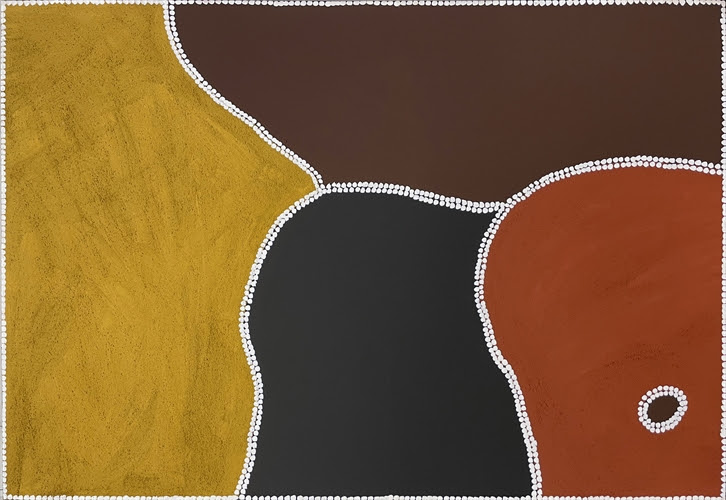
Image
 

Freddie Timms

Balgunny, 2004

Est. $10,000–$15,000

From cave walls to objects, the practice of painting in Australia's desert regions has evolved greatly over the years as a way of documenting familial history. In the 1980s, a younger generation of artists sought to protect these shared histories from a Western audience. This removal awakened a unique minimalist style of “dot painting” that has since been collected and coveted worldwide.


Artnet Auctions is pleased to offer an exciting selection of paintings by Aboriginal artists. Discover these works in our Aboriginal Art sale, live now through January 20.

 
Image
 
 
Image
 

Eileen Napaltjarri

Untitled, 2005

Est. $10,000–$15,000 

Joseph Jurra Tjapaltjarri 

Untitled, 2005

Est. $15,000–$20,000

 
Image
 
 
Image
 

Topsy Gibson Napaltjarri

Karrinyarra, 2004

Est. $3,000–$4,000

Warlimpirrnga Tjapaltjarri

Untitled, 2003

Est. $15,000–$20,000

 
Image
 
 
Image
 

Alison Puruntatameri

Pwoja Jilamara, 2019

Est. $3,000–$5,000

Emily Kame Kngwarreye

Untitled (13-496), 1996

Est. $25,000–$35,000