Saturday, December 9, 2023

Arab Strategic Miscalculations - Geopolitical Futures

Arab Strategic Miscalculations - Geopolitical Futures

Arab Strategic Miscalculations

Hamas’ Oct. 7 attack on Israel is the latest in a long line of strategic blunders.

Countries of all stripes – whether developed or underdeveloped, democratic or authoritarian – have been known to commit strategic military miscalculations. The U.S., for example, won decisive wars against developed countries such as Germany and Japan, but blundered in wars against much lesser powers like Vietnam in the 1970s and Iraq and Afghanistan after the 9/11 attacks.

Strategic military miscalculation usually results in the collapse of authoritarian regimes. The decision of Argentina’s military junta to invade the Falkland Islands in 1982 led to its defeat in the war against Britain and the fall of Gen. Leopoldo Galtieri’s regime. Iraq’s invasion of Kuwait in 1990 led to a military disaster for the Iraqi army following Operation Desert Storm, paving the way for the 2003 U.S. invasion of the country and the fall of Saddam Hussein’s regime. Successful countries eventually accept the need to revamp their political systems, initiate democratic reforms and champion world peace. It took Germany, whose army fought exceptionally well operationally and tactically, two world wars to metamorphose. It took Japan’s disastrous defeat precipitated by the Pearl Harbor attack to convince Tokyo to change. Under U.S. direction, the two countries transformed into full-fledged democracies.

Since the turn of the 20th century, political leaders, heads of state and political movements in the Arab world have also shown a propensity for massive miscalculation. Hamas’ Oct. 7 attack is a prime example, but it was precipitated by several other cases that have shaped the region since World War I.

Hamas’ Miscalculation

Hamas’ rationale for last month’s attack stemmed from its conviction that Israel, with U.S. backing and Arab acquiescence, intended to eliminate any possibility of Palestinian statehood. By taking Israeli hostages, it also intended to secure the release of thousands of Palestinian prisoners being held in Israeli jails, knowing that Israel has in the past been willing to conduct prisoner swaps. (In 2011, Israel released more than 1,000 Palestinian prisoners to secure the release of Gilad Shalit, an Israeli soldier detained by Hamas for more than five years.) However, Hamas failed to consider the likelihood that Israel’s war Cabinet would launch an unprecedented air and ground campaign following its attack, the scale of which recalled the genocidal horrors ingrained in Israel’s collective consciousness.

Gaza-Israel in the Middle East
(click to enlarge)

Hamas expected Israel to plead for negotiations to secure the freedom of some 240 Israeli captives. Images from Gaza on Oct. 7 showed Hamas guerrillas ecstatic about the possibility of a massive prisoner swap. But Israel instead unleashed a withering military campaign. Moreover, Hamas did not inform Iran and its regional allies in advance about its plans. It assumed Hezbollah would join the fighting from southern Lebanon and that Iraqi militias in Syria would engage Israel from the Golan Heights. Hezbollah’s unenthusiastic involvement in the war has cost it far more casualties than Israel and did not relieve even the slightest pressure on embattled Hamas. Hamas was left stunned by its allies’ tepid response, having previously believed its attack would transform the Middle East and pave the path toward establishing a Palestinian state. An extraordinary summit of Arab and Islamic countries held last month in Saudi Arabia resulted only in generic statements of support for the Palestinians and demands for the immediate cessation of hostilities. Hamas counted on the outbreak of a third intifada, but Israel’s preemptive raids against West Bank activists ruled out this possibility as well.

Arab Revolt in 1916

Hamas’ deadly miscalculation wasn’t unprecedented. The 20th century is rife with episodes of poor decision-making by Arab leaders, beginning with the anti-Ottoman Arab Revolt in 1916. The British feared that Ottoman Sultan Mehmed V’s declaration of jihad in November 1914 against Great Britain, France and Russia (the so-called Triple Entente) would dissuade Indian Muslims from fighting against the Central powers – which included, in addition to the Ottoman Empire, Germany, Austria-Hungary and Bulgaria. The British high commissioner in Egypt, Henry McMahon, tried to convince the emir of Mecca, Sharif Hussein bin Ali, to declare jihad on the Ottoman Empire in exchange for creating an Arab Kingdom in West Asia. In June 1916, Hussein launched the Arab Revolt, unaware that Britain and France had already signed five months earlier the Sykes-Picot agreement, which gave administration over Iraq and Palestine to London and over Syria and Lebanon to Paris. The British also promised the emir of Najd, Ibn Saud, to include Hejaz in his rapidly expanding emirate.

McMahon clarified to Hussein that the Arab kingdom would not include Palestine. Hussein’s son, Faisal, who was proclaimed king of Syria in 1920, had communicated with the president of the Zionist Organization, Chaim Weizmann, and accepted the Balfour Declaration, which promised to establish a Jewish homeland in Palestine. He later rescinded this agreement due to Arab opposition. Faisal also heeded the recommendation of the U.S.-sponsored King-Crane Commission, which called for autonomy of mainly Christian Mount Lebanon.

Despite Sharif Hussein’s concessions, the interests of Britain and France prevailed against those of the Hashemites. Nevertheless, in partial fulfillment of their promise to them, Winston Churchill, then secretary of state for the colonies, declared Faisal king of Iraq in 1921 and his brother, Abdullah I, emir of Transjordan. However, Britain found working with Ibn Saud in Arabia more practical. The British allowed Ibn Saud to extend his territorial authority to Hejaz, provided he did not impinge on Britain’s sphere of influence in the Persian Gulf emirates, Transjordan and Iraq.

1948 Blunder

The Arab summits over the Palestine issue in 1946 in Egypt and Syria did not refer to military intervention in Palestine. They primarily rejected the recommendations of the Anglo-American Commission, which called for creating two states in Palestine, one Jewish and another Arab. They also promised to provide Palestinians with financial aid. Even the Egyptian secretary-general of the Arab League, Abd al-Rahman Azzam, totally opposed the war and advocated negotiations with the Zionist movement. Prominent politician Sidqi Pasha told Egypt’s Senate that the army was unfit for war and would lose if it took on the Haganah, a Zionist military organization that represented the Jews before Israel’s establishment.

King Farouk made the surprise decision to invade Palestine in 1948 against the recommendation of the Egyptian army and Cabinet – despite Prime Minister Mahmud Nuqrashi Pasha’s belief that the Palestine question was not a matter of vital national interest, and the Cabinet’s vote against committing the military to war. The army’s chief of staff did not believe the troops could go to war, let alone win, in part because the army deemed more than 80 percent of military-age Egyptians unfit for military service due to rampant hepatitis, schistosomiasis, malnutrition and illiteracy.

In the first communique broadcasted by the coup plotters on July 23, 1952, Anwar Sadat claimed that bribable officials in the defunct regime had purchased defective weapons, including artillery that exploded when firing during the 1948 Arab-Israeli war, leading to the defeat of the Egyptian army. However, investigations after the fall of the monarchy concluded that three artillery units exploded during loading due to poor training, not malfunctioning.

Egypt lost the war due in part to the lack of coordination with the Iraqi army and Jordan’s Arab Legion, the best-trained and most efficient army during the war, and in part to militarily unfit Egyptian troops, the absence of a war strategy and low morale. Farouk was determined to prevent the Hashemites in Iraq and Jordan from becoming the most significant royal power in the Middle East. At the same time, the Hashemites hoped to blunt Farouk’s ambition, especially since he entertained the idea of resurrecting the Islamic caliphate, which was disbanded in 1924 by Turkey’s Kemal Ataturk, and declaring Cairo its capital city. The Hashemites had achievable objectives, while Farouk had visions of grandeur.

Suez and the Straits of Tiran

Egyptian President Gamal Abdel Nasser made a grave mistake when he nationalized the Suez Canal in 1956. His decision led three months later to the outbreak of the Suez War, which saw Britain, France and Israel declare war on Egypt, resulting in a disastrous military defeat for Cairo.

At the time of the canal’s nationalization, just 12 years remained of the original 99-year Anglo-French concession. Yet, the material losses that resulted from its nationalization, such as the seizure of Egyptian assets in European banks and the compensation paid to foreign shareholders, far exceeded the proceeds of nationalization. At the same time, the war and sanctions precipitated the beginning of the collapse of the Egyptian currency. Thousands of Egyptian soldiers and civilians were killed, and most of the hardware that Nasser had procured from former Czechoslovakia was destroyed. The war also destroyed modern European-style cities built by the British and French along the Suez Canal, such as Port Said, Port Fouad and Ismailia, and displaced hundreds of thousands of Egyptians. Furthermore, the U.N. General Assembly established the United Nations Emergency Force to patrol the border with Israel, stationed in the Sinai Peninsula, the Gaza Strip and Sharm el-Sheikh, allowing Israeli ships to cross the Straits of Tiran to the Red Sea for the first time since King Farouk banned them in 1950. Nasser’s reversion to the status quo ante in 1967 triggered the Six-Day War.

Egypt’s military was defeated, but diplomatically the war was a success. U.S. President Dwight Eisenhower coerced the tripartite alliance to pull out of Egypt, and Nasser’s prestige as the champion of Arab nationalism soared. During the interwar period leading to the 1967 war, Nasser bragged about building the most potent armed forces in the eastern Mediterranean. However, his Arab critics ridiculed him for allowing Israeli shipping through the Straits of Tiran. Over time this issue soured Nasser’s image, and he waited for an opportunity to undo it.

His chance came in May 1967. The Soviet Union warned Nasser about an Israeli military buildup near the Golan Heights in preparation for invading Syria. It was a false alarm, but even after discovering this, Nasser sent his army to Sinai in a spectacular military parade without intending to go to war. He also decided to block Israeli shipping from the Gulf of Aqaba into the Red Sea. Israel considered Nasser’s action as a casus belli and decided to complete the unfinished 1948 war.

The operational problems that plagued the Egyptian military in the 1948 and 1956 wars were still apparent in 1967. The Egyptian armed forces were unprepared for war, given their poor and politicized leadership and insufficient training. Moreover, Nasser assumed that the U.S. would resort to secret diplomacy to defuse the crisis. In 1960, during the union years between Egypt and Syria, Nasser sent his army to Sinai to relieve the pressure on the Syrian army after a major confrontation in the Golan Heights. Eisenhower used his leverage with Israel to restore quiet along the northern armistice line. But in 1967, President Lyndon Johnson’s administration, fed up with Nasser’s anti-American rhetoric, gave Israel the green light to launch the war. Israeli forces swept to victory against Egypt, Syria and Jordan. The political mood in Washington had changed, and Nasser’s failure to understand it caused a geopolitical earthquake that is still reverberating throughout the region.

Iraq’s Invasion of Kuwait

Iraq won the 1980-88 war with Iran but emerged economically battered from it. To cover the cost of the war, Iraq had borrowed billions of dollars from Saudi Arabia, the United Arab Emirates and Kuwait. Unlike the Saudis and Emiratis, who wrote off Iraqi debt, Kuwait insisted that Saddam Hussein repay the $14 billion that Iraq owed. Iraq accused Kuwait of exceeding its oil production quota to lower crude oil prices, an untenable situation for Iraq, whose oil revenues were insufficient to cover the salaries of the bureaucracy and the large standing army. Baghdad also accused Kuwait of stealing Iraqi oil from the Rumaila oil field through slant drilling.

Saddam did not comprehend the complexity of international relations. He had spent years in prison and had not completed his college education. The only non-Arab capitals he had visited were Moscow and Paris. He did not grasp that Iraq, a country carved out by Britain in 1921, could not erase Kuwait, another country created by the British. Saddam based his decision to invade Kuwait on a cursory conversation with April Glaspie, then U.S. ambassador to Iraq, who told him that the U.S. had no policy on intra-Arab relations, which he understood to mean that the U.S. would only verbally condemn the invasion of Kuwait. He believed that invading Kuwait before the impending collapse of the Soviet Union would spare him the wrath of the U.S., unaware that the bipolar international system that shielded Third World countries already had ceased to exist.

Saddam’s reckless decision to invade Kuwait decimated the Iraqi army. A multinational military coalition intervened to reinstate Kuwait’s independence, and Iraq was subjected to severe sanctions, marking the end of its status as a rising regional power. In 2003, the U.S. invaded Iraq and toppled Saddam’s regime, enabling Iran to creep in and dominate the country.

Misunderstanding How the World Works

Arab leaders, engrossed in a distorted worldview, tend to see the world through the prism of their domestic politics, often failing to comprehend the complexity of international relations. Arabs in high office are autocrats who do not answer to anybody else, driving them to make fateful decisions. Many Arab leaders live in echo chambers, making decisions premised on faulty assumptions, inattentive to how their antagonists might respond. The consequences have played out time and again, including today in Gaza.

Where Does Our Consciousness Live? It’s Complicated

Where Does Our Consciousness Live? It’s Complicated

Skip to Content

Logo

Your Very Own Consciousness Can Interact With the Whole Universe, Scientists Believe

A recent experiment suggests the brain is not too warm or wet for consciousness to exist as a quantum wave that connects with the rest of the universe.

Headshot of Susan LaheyBY SUSAN LAHEY

PUBLISHED: OCT 18, 2023

bookmarks


Getty Images

When people talk about consciousness, or the mind, it’s always a bit nebulous. Whether we create consciousness in our brains as a function of our neurons firing, or consciousness exists independently of us, there’s no universally accepted scientific explanation for where it comes from or where it lives. However, new research on the physics, anatomy, and geometry of consciousness has begun to reveal its possible form.

In other words, we may soon be able to identify a true architecture of consciousness.

The new work builds upon a theory Nobel Prize-winning physicist Roger Penrose, Ph.D., and anesthesiologist Stuart Hameroff, M.D., first posited in the 1990s: the Orchestrated Objective Reduction theory (Orch OR). Broadly, it claims that consciousness is a quantum process facilitated by microtubules in the brain’s nerve cells.

now Your Terms: Microtubules

These are tubes made of protein lattices, and they form part of the cell’s cytoskeleton, which is its structural network.

Penrose and Hameroff suggested that consciousness is a quantum wave that passes through these microtubules. And that, like every quantum wave, it has properties like superposition (the ability to be in many places at the same time) and entanglement (the potential for two particles that are very far away to be connected).

Plenty of experts have questioned the validity of the Orch OR theory. This is the story of the scientists working to revive it.

Across the Universe

To explain quantum consciousness, Hameroff recently told the TV program Closer To Truth that it must be scale invariant, like a fractal. A fractal is a never-ending pattern that can be very tiny or very huge, and still maintain the same properties at any scale. Normal states of consciousness might be what we consider quite ordinary—knowing you exist, for example. But when you have a heightened state of consciousness, it’s because you’re dealing with quantum-level consciousness that is capable of being in all places at the same time, he explains. That means your consciousness can connect or entangle with quantum particles outside of your brain—anywhere in the universe, theoretically.


An illustration of the brain’s network of neural axons transmitting electrical action potentials. (Getty Images)

Other scientists had an easy way to discard this theory. Efforts to recreate quantum coherence—keeping quantum particles as part of a wave instead of breaking down into discrete and measurable particles—only worked in very cold, controlled environments. Take quantum particles out of that environment and the wave broke down, leaving behind isolated particles. The brain isn’t cold and controlled; it’s quite warm and wet and mushy. Therefore, consciousness couldn’t remain in superposition in the brain, the thinking went. Particles in the brain couldn’t connect with the universe.

But then came discoveries in quantum biology. Turns out, living things use quantum properties even though they’re not cold and controlled.

Know Your Terms: Quantum biology

This is the study of quantum processes in living organisms, like superposition and quantum entanglement, that actually facilitate biological processes beyond the subatomic level. 

Photosynthesis, for example, allows a plant to store the energy from a photon, or a quantum particle of light. The light hitting the plant causes the formation of something called an exciton, which carries the energy to where it can be stored in the plant’s reaction center. But to get to the reaction center, it has to navigate structures in the plant—sort of like navigating an unfamiliar neighborhood en route to a dentist appointment. In the end, the exciton must arrive before it burns up all of the energy it’s carrying. In order to find the correct path before the particle’s energy is used up, scientists now say the exciton uses the quantum property of superposition to try all possible paths simultaneously.

New evidence suggests microtubules in our brains may be even better at guarding this quantum coherence than chlorophyll. One of the scientists who worked with the Orch OR team, physicist and oncology professor Jack Tuszynski, Ph.D., recently conducted an experiment with a computational model of a microtubule. His team simulated shining a light into a microtubule, sort of like a photon sending an exciton through a plant structure. They were testing whether the energy transfer from light in the microtubule structure could remain coherent as it does in plant cells. The idea was that if the light lasted long enough before being emitted—a fraction of a second was enough—it indicated quantum coherence.

Specifically, Tuszynski’s team simulated sending tryptophan fluorescence, or ultraviolet light photons that are not visible to the human eye, into microtubules. In a recent interview, Tuszynski reports that, across 22 independent experiments, the excitations from the tryptophan created quantum reactions that lasted up to five nanoseconds. This is thousands of times longer than coherence would be expected to last in a microtubule. It’s also more than long enough to perform the biological functions required. “So we are actually confident that this process is longer lasting in tubulin than … in chlorophyll,” he says. The team published their findings in the journal ACS Central Science earlier this year.

Put simply, the brain is not too warm or wet for consciousness to exist as a wave that connects with the universe.

Tuszynski notes that his team is not the only one sending light into microtubules. A team of professors at the University of Central Florida has been illuminating microtubules with visible light. In those experiments, Tuszynski says, they observed re-emission of this light over hundreds of milliseconds to seconds. “That’s the typical human response time to any sort of stimulus, visual or audio,” he explains. Shining the light into microtubules and measuring how long the microtubules take to emit that light “is a proxy for the stability of certain … postulated quantum states,” he says, “which is kind of key to the theory that these microtubules may be having coherent quantum superpositions that may be associated with mind or consciousness.” Put simply, the brain is not too warm or wet for consciousness to exist as a wave that connects with the universe.

While this is a long way from proving the Orch OR theory, it’s significant and promising data. Penrose and Hameroff continue to push the boundaries, partnering with people like spiritual leader Deepak Chopra to explore expressions of consciousness in the universe that they might be able to identify in the lab in their microtubule experiments. This sort of thing makes many scientists very uncomfortable.

Still, there are researchers exploring what the architecture of such a universal consciousness might look like. One of these ideas comes from the study of weather.

The Architecture of Universal Consciousness

Timothy Palmer, Ph.D., is a mathematical physicist at Oxford who specializes in chaos and climate. (He’s also a big fan of Roger Penrose.) Palmer believes the laws of physics must be fundamentally geometric. The Invariant Set Theory is his explanation of how the quantum world works. Among other things, it suggests that quantum consciousness is the result of the universe operating in a particular fractal geometry “state space.”

That’s a mouthful, but it roughly means we’re stuck in a lane or route of a cosmic fractal shape that is shared by other realities that are also stuck in their trajectories. This notion appears in the final chapter of Palmer’s book, The Primacy of Doubt, How the Science of Uncertainty Can Help Us Understand Our Chaotic World. In it, he suggests the possibility that our experience of free will—of having had the option to choose our lives, as well as our perception that there is a consciousness outside ourselves—is the result of awareness of other universes that share our state space. The idea starts with a special geometry called a Strange Attractor.

You may have heard of the Butterfly Effect, the idea that the flap of a butterfly’s wing in one part of the world could affect a hurricane in another part of the world. The term actually refers to a more complex concept developed by mathematician and meteorologist Edward Lorenz in 1963. Lorenz was trying to simplify the equations used to predict how a particular climate condition might evolve. He narrowed it down to three differential equations that could be used to identify the “state space” of a particular weather system. For example, if you had a particular temperature, wind direction, and humidity level, what would happen next? He began to plot the trajectory of weather systems by plugging in different initial conditions into the equations.

text

He found that if initial conditions were different by even one one-hundredth of a percent, if the humidity was just a fraction higher, or the temperature a hair lower, the trajectories—what happens next—could be wildly different. In the graph, one trajectory might shoot off in one direction, forming loops and spins, seemingly at random, while another creates completely different shapes in the opposite direction. But once Lorenz started to plot them, he found that many of the trajectories wound up circulating within the boundaries of a particular geometric shape known as a strange attractor. It was as if they were cars on a track: the cars might go in any number of directions so long as they didn’t drive it the same way twice and they stayed on the track. The track was the butterfly-shaped Lorenz attractor.

lorenz attractor in rainbow colors


Artwork of a Lorenz attractor, named after Edward Lorenz, who developed a system of ordinary differential equations. In particular, the Lorenz attractor is a set of chaotic solutions of the Lorenz system which, when plotted, resemble a butterfly or figure eight. Minute variations in the initial values of the variables would lead to hugely divergent outcomes. For this phenomenon, of sensitivity to initial conditions, he coined the term butterfly effect. This effect is the underlying mechanism of deterministic chaos.

Getty Images

Palmer believes that our universe may be just one trajectory, one car, on a cosmological state space like the Lorenz attractor. When we imagine “what if …?” scenarios, we’re actually getting information about versions of ourselves in other universes who are also navigating the same strange attractor—others’ “cars” on the track, he explains. This also accounts for our sense of consciousness, of free will, and of being connected with a greater universe.

“I would at least hypothesize that it may well be the case that it’s evolving on very special fractal subsets of all conceivable states in state space,” Palmer tells Popular Mechanics. If his ideas are correct, he says, “then we need to look at the structure of the universe on its very largest scales, because these attractors are really telling us about a kind of holistic geometry for the universe.”

Tuszynksi’s experiment and Palmer’s theory still don’t tell us what consciousness is, but perhaps they tell us where consciousness lives—what kind of a structure houses it. That means it’s not just an ethereal, disembodied concept. If consciousness is housed somewhere, even if that somewhere is a complicated state space, we can find it. And that’s a start.


SUSAN LAHEY

CONTRIBUTOR

Susan Lahey is a journalist and writer whose work has been published in numerous places in the U.S. and Europe. She's covered ocean wave energy and digital transformation; sustainable building and disaster recovery; healthcare in Burkina Faso and antibody design in Austin; the soul of AI and the inspiration of a Tewa sculptor working from a hogan near the foot of Taos Mountain. She lives in Porto, Portugal with a view of the sea.

Read full bio


(1) The Collapse of the Unipolar World | Felix Zulauf - YouTube

(1) The Collapse of the Unipolar World | Felix Zulauf - YouTube

Fair Shares of Debt - Mauldin Economics

Fair Shares of Debt - Mauldin Economics

The IRS publishes distributional data on this. Here’s how it looked in 2020 (latest available).


Source: Heritage Foundation

In this year (which is typical), the top 1% of taxpayers collectively earned 22% of the total adjusted gross income and paid 42% of the total taxes. The next 4% had 16% of AGI and paid 20% of the taxes. Below that, tax paid is proportionately the same or less than earnings.

Tuesday, December 5, 2023

Money Stuff: Whose Income Do You Pay Taxes On? - btbirkett@gmail.com - Gmail

Money Stuff: Whose Income Do You Pay Taxes On? - btbirkett@gmail.com - Gmail...The other reason that this stuff is getting more attention is a fairly minor one involving a law that Congress passed in 2017 to change how foreign corporate income is taxed. The Wall Street Journal explains:

Before then, U.S. companies paid foreign taxes on foreign profits but could defer any U.S. taxes until they brought earnings back home. Republicans switched to a system with a minimum annual U.S. tax on foreign profits and tax-free repatriation.

In that transition, to deal with 30 years of profits companies had accumulated overseas that hadn’t faced U.S. taxation, Congress imposed a one-time levy. 

....But the tax also applied to some individuals, including those who owned more than 10% of a foreign corporation.  

...This is what happened to Charles and Kathleen Moore, who in the early 2000s put $40,000 into a friend’s “business to supply farmers in India’s most impoverished regions with basic tools and equipment.”[8] That investment bought them about 13% of the stock in the friend’s Indian corporation, KisanKraft Machine Tools Private Limited. It did well and “was profitable almost from the start”; “Charles visited India several times and was impressed with the difference that KisanKraft was making in the lives of India’s rural poor,” but “the Moores never received any distributions, dividends, or other payments from KisanKraft,” and “as minority shareholders without any role in KisanKraft’s management, they had no ability to force the company to issue a dividend.”

And in 2018 they were hit with a $14,729 tax bill on $135,512 of historical KisanKraft earnings. They paid, sued for a refund, lost in lower courts, and appealed to the US Supreme Court, which will hear their arguments tomorrow. They argue that this isn’t income to them, so they shouldn’t have to pay taxes. The argument is that an income tax has to be based on “income they had realized,” that is, money that they actually got, not just on their ownership of property. Here is their brief.

...Here is the government’s brief, which I find more convincing. Among other things it points out that this stuff happens all the time: Partners (and limited liability company members, and S corporation shareholders) pay taxes on their businesses’ income, whether or not they actually get it in cash. If the Supreme Court decides that that’s unconstitutional, then most of the regime of US business taxation is unconstitutional.[9

... If a company sells a zero-coupon bond for $50, and it matures in five years and pays back $100, the buyer of the bond is treated as getting $10 a year of interest income,[10] even though she doesn’t actually get paid any interest until the end.

...If Congress really might tax any increase in wealth, whether or not it is realized, then that opens up a lot of new taxing possibilities, which makes people nervous. But if Congress can’t tax any unrealized increase in wealth, then that closes off a lot of taxes that already exist.


Startups Are Further From Solving The Affordable Housing Shortage

Startups Are Further From Solving The Affordable Housing Shortage

Startups Are Further From Solving The Affordable Housing Shortage

Illustration of a hand holding a house made of money. [Dom Guzman]

For those of us hoping innovative startups might succeed in solving the affordable housing shortage, recent news has not been reassuring.

One of the most heavily funded unicorns in the space — modular housing developer Veev —  was reported last week to be on the verge of shutting down. Previously, it had raised $585 million in venture funding, including $400 million just last year.

Veev is a prominent name in a long list of affordable housing-related startups that scaled up during the boom years. While the San Mateo, California-based company only produced a limited number of dwellings to date, it had a longer-term vision of enabling mass-production of new homes with prefab components and standardized building processes.

It was one of several hefty fundraisers in the space. In our last report on funding to affordable housing-related startups in the summer of 2022, we put together a list containing 24 U.S. companies that had collectively brought in close to $2 billion.

There were plenty of compelling-sounding business models in the mix too, from high-tech construction robots to mass-produced backyard cottages. Some were even rolling out 3D-printed houses.

So what happened post-peak? Broadly, funding to startups focused on affordable housing and more efficient construction technologies is down significantly from a couple years ago. This isn’t surprising, given that global startup funding to most sectors has contracted sharply.

Who’s getting funded?

Even with the funding pullback, we are still seeing some investment around the affordable housing theme.

This includes some startups on our 2022 list that raised funding this year. Oakland, California-based Mighty Buildings, a maker of factory-built, 3D printed panels that can be efficiently assembled into homes, picked up $52 million in a September financing. And Rialto, California-based Plant Prefab, which also develops prefabricated panels for residential construction, secured $44 million in a January Series C.

As for early-stage rounds, one standout was Samara, a startup founded by Airbnb co-founder Joe Gebbia that builds backyard cottages for homeowners. A month ago, the company landed a $41 million Series A led by Thrive Capital.

In a similar vein, Villa Homes, a maker of prefab accessory dwelling units, picked up $6.3 million in July, per a securities filing. Meanwhile Boxabl, a developer of mass-produced homes known for its backyard casita model, picked up a few million more in crowdfunded investments this year.

But while rounds are getting done, no one would call affordable housing a hot theme for startup investment. We’re not really seeing new unicorns, nor are there any buzzy companies expected to be going public soon.

Not exactly cheap

One issue confronting startups innovating around housing affordability is that their initial products often aren’t cheap.

Veev, for example, has sold a few homes developed using its components and production processes, but they’re on the high end. A six-bedroom Palo Alto home, for example, sold for $7.6 million this year. A condo in the Silicon Valley city of San Carlos sold for $1.3 million.

In an interview last year, Veev CEO Amit Haller told Crunchbase News that the goal of more affordable housing will require building at scale. In a more ideal world, he envisioned that building homes would be more like churning out iPhones. The resultant product would be available at mass scale and of high enough quality to appeal to consumers of all means.

But this presents a sort of chicken-and-egg dilemma. It’s tough to make affordable housing without scale. And it’s difficult to scale something that people can’t initially afford to buy.

Other startups have cheaper offerings, but still not exactly low cost. Samara’s lineup, for instance, starts at $279,000 to put a small studio in the backyard of an existing home. Villa estimates that its smallest cottage — a 569-square-foot one-bedroom — would cost $295,000 to build and install.

Boxabl, by contrast, racked up a long wait list a couple years ago by saying its casita tiny house would cost around $49,000, not including installation. Currently, however, the company says it can no longer promise a fixed price.

Meanwhile, affordability isn’t improving

The tough fundraising climate for startups working on scalable approaches to housing comes as consumers continue to struggle to afford homes.

In August, the National Association of Realtors reported that U.S. housing affordability hit a historical low, driven by rising mortgage interest rates and low inventory of homes for sale. In the least affordable metros, including New York, Miami and Los Angeles, buying a home remains financially out of reach for most residents.

Venture investors, however, seem to be indicating with their wallets that they don’t believe many startups are presently poised to find a way around this particular problem.

Saturday, December 2, 2023

Healthcare, a Minor Major Problem - btbirkett@gmail.com - Gmail

Healthcare, a Minor Major Problem - btbirkett@gmail.com - Gmail

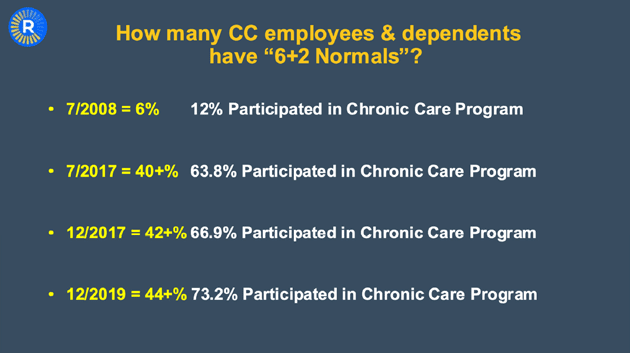
...There are simpler things we can do, too. My friend Dr. Michael Roizen initiated a program for employees of the Cleveland Clinic and saw significant, if not monster, improvement in health care costs. Essentially, Cleveland Clinic pays workers to adopt healthy lifestyles. Control your blood pressure (meds if needed), don't smoke, exercise, control your weight, reduce your fasting blood sugar and cholesterol, and do something to relieve stress. It cut their costs relative to the national average by 38% and rising.

The program is optional and participating employees received significantly reduced healthcare costs. Those who don’t participate pay the difference on their own. Not surprisingly, the participation rate soared over the last decade, from 12% to now over 75%. (Table only goes to 2019.)


Source: Cleveland Clinic

Cleveland Clinic saved almost a billion dollars in 2018 and it’s now over $1.5 billion a year, according to Mike. That is huge for a company with “just” 40,000 employees.


Source: Cleveland Clinic

Other companies are following this example. What if we did something similar nationally?

Remember that $22,000 per person projected Medicare cost in 2033? What if we dropped it 40%? Plus have everyone on any form of government-subsidized insurance adopt the same program? Do some simple things and pay less for your insurance or live an unhealthy lifestyle and pay more.