Wednesday, February 24, 2021

Big Buildings Can Cause Cities to Sink Faster - Bloomberg

Big Buildings Can Cause Cities to Sink Faster - Bloomberg

Cities Are Sinking Under the Weight of Urban Development

A new study quantifies what big buildings are doing to the ground beneath San Francisco and other cities, as sea levels rise.


By Linda Poon

February 23, 2021, 12:23 PM EST Updated on February 23, 2021, 3:55 PM EST


Millennium Tower (left) in San Francisco has sunk 16 inches since construction was completed ten years ago. Other big buildings like it are contributing to sinking ground across the city, a new study warns. 


In late 2020, engineers began working on a $100 million project to stop San Francisco’s Millennium Tower from tilting and sinking further into the ground. Tenants of the beleaguered luxury condo had learned four years earlier that the 58-story high-rise had sunk some 16 inches in over a decade. But the tower’s predicament is only part of a larger problem, and not just for the Bay Area: Cities around the world are sinking under the weight of their own urban development — at the same time that sea levels are rising.


A new study seeks to quantify how much the sheer weight of the built environment contributes to the sinking of cities, a geological phenomenon known as land subsidence. While urbanization is just one small cause of this phenomenon among several, the paper in the journal AGU Advances estimates that its impact is only likely to grow as people move to cities in greater numbers. As a result, densely packed cities are likely to sink faster than less developed areas.


Study author Tom Parsons, an earthquake seismologist at the U.S. Geological Survey, looked at the San Francisco Bay Area as a case study of this impact. He estimates that the collective weight of all of the San Francisco region’s buildings is roughly 1.6 trillion kilograms, or 3.5 trillion pounds. That alone may have caused the land to sink by as much as 80 millimeters, or more than three inches, over time as the city grew.


That is a conservative estimate, says Parsons. “It's pretty much impossible to try to account for every single item in a city,” he says. “But I figured that most of the stuff that we have in cities is inside buildings.”


His model for calculating those numbers uses public data about the height and base outline of each building in the San Francisco Bay Area, and makes broad assumptions about their makeup and the contents inside. It doesn’t include other mass sources like roads, bridges and other paved areas, nor does it factor in humans.


Still, the pressure of buildings alone is enough to contribute to the sinking of the region. Previous research in 2018 suggested that coastal areas in the densely packed region around San Francisco, with a population of more than 7 million, are sinking at a rate of nearly 2 millimeters a year. Some areas are settling by as much as 10 millimeters annually. The region also faces threats of catastrophic flooding as sea levels are expected to rise by nearly a foot by 2050, and by three feet by the end of the century.


While factors like groundwater pumping, erosion and the shifting of tectonic plates are often the major causes of subsidence, Parsons’s paper zooms in on the San Francisco region to explain how urbanization also plays a small but not insignificant role. “In a super-urbanized area like downtown San Francisco, there’s a lot of pressure in a small area,” he says. It’s enough to cause the Earth’s rocky outer crust, or the lithosphere, to deform and sink, though only by a few millimeters each year.


Then there’s the fact that many of the city’s buildings are built on soil, which compresses more easily, causing the ground to sink even more over time. Engineers usually plan for this effect. “When they first put up a building, it’s going to settle. It could settle 8 or 10 millimeters right away,” says Parsons. “Over time, the buildings, especially the big heavy ones, can continue to settle

indefinitely as the soil underneath starts to creep and flow down, especially if the soil is clay rich.”


The impact of all this downward pressure may be small compared to the other contributors of land subsidence. But Parsons argues that the weight of urban development will be increasingly significant all over the world as people continue migrating to cities, which will in turn see more development to accommodate the population increase.  By one estimate, some 70% of the world’s population will live in large urban areas by 2050.


“It’s not a huge concern at the moment relative to other things, but the issue is going to grow as we continue to pile on massive developments,” he says. “Especially in developing countries, where there could be a 50% increase in the amount of people flocking into coastal regions. Construction is going to follow.”


The paper points to Lagos, Nigeria, where the urban population of more than 14 million is expected to double over the next three decades. The city is currently sinking at between 2 and 87 millimeters (or 3.4 inches) per year. Parts of the city that are along the coast, where “heavy structures are built on poorly consolidated sediments,” Parsons writes, are seeing higher rates of subsidence.


In developed cities, there isn’t much that can be done to reverse the effect of urbanization. In Indonesia, leaders finally pushed forward a plan to move the capital city out of Jakarta in part to lessen the strain on the overcrowded city, but it’s already the fastest sinking metropolis in the world. Excessive groundwater pumping has led the city to settle, or sink, around 10 centimeters per year, with some coastal areas, where poorer residents face chronic flooding, are sinking at some 25 millimeters a year.


“If you're intent on urbanizing a place, it’s not really something you can do much about,” Parson says. “It’s just gravity pushing down, you can’t really fight that.” There are some mitigating factors to consider, however. Where you build and what land you build on matters in the long run. Cities may want to reconsider plans to build heavily near the coast, or atop of reclaimed land, which is susceptible to subsidence.


They may also want to rethink their urban drainage system. When planners pave over soil, it typically reroutes drainage away from their traditional river sources and right into the largest nearby body of water, whether it be an ocean or a bay. So “a lot of the settlements that would normally accumulate in the delta just get sent right out into the ocean,” he says. That causes the ground to continually compact over time, and accelerate the sinking of the city. 


The key is to think about all this ahead of time. Otherwise, “as cities get denser and denser, and build taller and taller, there could be some issues going forward.”


Monday, February 22, 2021

After Trump, America's Churches Are More Polarized Than Ever - Bloomberg

After Trump, America's Churches Are More Polarized Than Ever - Bloomberg

America’s Churches Are Now Polarized, Too

In religion as in politics, the legacy of Trumpism casts a long shadow.


By Francis Wilkinson

February 21, 2021, 8:00 AM EST

A prayer on Jan. 6.

A prayer on Jan. 6. Photographer: Win McNamee/Getty Images North America

Francis Wilkinson writes about U.S. politics and domestic policy for Bloomberg Opinion. He was previously executive editor of the Week, a writer for Rolling Stone, a communications consultant and a political media strategist.


On the first Sunday after the assault on the U.S. Capitol in January, the Rev. Bill Corcoran stood before his socially distant parishioners at St. Elizabeth Seton Catholic Church in suburban Chicago and finally, unambiguously, crossed the line.


“Over the past four years,” he said, “I have failed you by not speaking out when awful things were said and done.” He should have spoken up, he said, about Donald Trump’s abuse of women, his contempt for truth, his mocking of a disabled reporter, his denigration of political rivals, his disrespect for the parents of a dead soldier.


As everyone in the pews understood, Corcoran’s mea culpa implicated more than a lone parish priest. If Corcoran was wrong not to have denounced Trump’s bad words and deeds, what of the parishioners who had supported them, and then voted for more?


Reaction was swift. A dozen congregants walked out of 7:30 Mass, Corcoran told the Chicago Tribune. Nearly two dozen at 9:30. About 30 more at 11:30. Corcoran was “rattled” as he watched members of his flock turn away, he told me in an email.


America’s 380,000 churches have long managed political conflict. Issues such as abortion, capital punishment and government aid to the poor all have a religious valence. But as political polarization has grown more intense, the most sacred spaces have grown more vulnerable to it. Some churches have turned to professional moderators to help keep congregations together.


“I’ve been studying religion and religious congregations for 30 years,” said Michael O. Emerson, a sociologist at the University of Illinois at Chicago and an author of numerous books on American religion. “This is a level of conflict that I’ve never seen. What is different now? The conflict is over entire worldviews — politics, race, how we are to be in the world, and even what religion and faith are for.”


***


The erosion of White Christian power in a nation historically dominated by White Christian men has posed new challenges. According to a Pew Research Survey released in February, 58% of Republicans expect “White people” to lose influence under President Joe Biden. In a January poll by the American Enterprise Institute, a majority of Republicans agreed that “the traditional American way of life is disappearing so fast that we may have to use force to save it.”


The insecurities of White Christian conservatives have created a robust market for demagogy along with a rationale for political extremism. Trump warned his followers time and again that if his political opponents gained power, “You won’t have a country anymore.” Fox News builds its nightly programming around the same message of fear and victimization. Millions carry their grievances through the week, Sundays very much included.


Fear of racial and cultural change on the right has been met with, and exacerbated by, moral revulsion on the left. Liberal churchgoers found it inconceivable that Christians occupying adjacent pews had supported a man who had spent a lifetime subverting Christian values and who ran his campaign on racial aggression. Many deemed a vote for Trump not simply wrongheaded, but unconscionable.


“The astonishment of the left at the election of Trump produced high tension in churches in 2016 and 2017,” said Allen Hilton, executive director of House United, a nonprofit he founded in 2016 to work on bridging partisan divides. Churches soon became two-thirds of his clientele. “I probably visit 30 churches a year,” Hilton said. The erosion of trust among congregants after Trump’s election, he said, was “standard operating procedure in those churches, whether they were left-leaning churches that had a few right people, or right-leaning that had a few left people.”


Steve Bezner, senior pastor of Houston Northwest Church, a Southern Baptist congregation in Houston, Texas, said the effects of partisan tribalism, intensified by social media, are increasingly apparent in the feedback he gets from church members on both sides of the divide. “Talking points become drivers of opinion instead of Scripture,” he said in a telephone interview. “When I recently preached a sermon in which I spoke about caring for the poor, there were a couple comments made to me afterward about how that was pushing a ‘liberal agenda.’ Obviously, caring for the poor is pretty central to the New Testament.”


Lydia Bean is a sociologist and author of a book on evangelical churches on each side of the U.S.-Canada border. She’s also a Democrat who ran unsuccessfully for the Texas House of Representatives and a member of Broadway Baptist Church in Fort Worth, Texas. At Broadway Baptist, she said in a telephone interview, “most leaders in the church would say that their goal is to be welcoming to both Republicans and Democrats.”


Trumpism’s aggression, however, is difficult to map onto even the most pliable Christian moral framework. How do you christen a policy of strategic sadism inflicted on migrant and refugee children?


“It just made it really apparent that there’s not a shared moral worldview between those who support and those who oppose Trump,” Bean said. “Either separating children from their families is wrong or it’s not. But, all of a sudden, that’s supposed to be something that we agree to disagree on in the congregation? I don’t think so.”


***


The spread of political extremism has brought tensions even to solidly conservative congregations. Battles over face masks and in-person services became proxies for deeper struggles.


“There are pastors who are exhausted,” said Russell Moore, president of the Ethics & Religious Liberty Commission of the Southern Baptist Convention. Moore cited the case of a pastor “who doesn’t engage in any political talk at all but simply offered a prayer for President Biden, as we’re commanded to do in the Bible, to pray for our leaders. And a woman started yelling at him from the congregation that Biden is not president, that it was a stolen election and so forth.”


Propaganda and violent fantasies pervade MAGA culture. The pathological miasma of QAnon, in which Trump is portrayed as a kind of Muscle Jesus with superhero accents, ends with the mass execution of perfidious Democrats. “I write a newsletter every Monday,” Moore told me. One week, “I was responding to more questions than I could count from people saying, ‘What do I do with family members who have embraced conspiracy theories and are into QAnon and so forth.’ So even in places where that’s not affecting the church, it’s still affecting the larger ecosystem where these people live.”


Much discussion of religion in the Trump era focused on his devoted following of White evangelical conservatives. Serial business failure and manic self-indulgence were recast for evangelical audiences as crucibles by which Trump was tempered by an affirming God. The lacerating news media and Russia-obsessed Democrats played the role of Pontius Pilate to Trump’s divinely sanctioned savior.


Yet Trump’s appeal was never confined to evangelical conservatives. And it persisted even after his months-long attempt to overthrow the government culminated in a violent cataclysm. “At the end of the year, following the riots at the U.S. Capitol, White mainline Protestants reported nearly identical favorability levels for Trump (41%) and Biden (44%),” noted Robert Jones, CEO of the Public Religion Research Institute, in an email.


The attack on the Capitol pushed some congregations to draw a line, just as Father Corcoran finally did. At Lydia Bean’s Baptist Church in Fort Worth, “We issued a statement against the insurrection and defending democracy and the results of the election,” she said. “That was a big step for us. We hadn’t made that kind of public statement before.”


Since the attempted coup, said Allen Hilton, the executive director of House United, he has seen an “increased opening” for discussions among Democrats and Republicans in churches. “Conversations right now are actually pretty productive,” he said. He likened many Republican churchgoers to Senate Republican leader Mitch McConnell, whose partisanship is unshaken but who has distanced himself from Trump and disavowed the violent fantasies of QAnon. “People don’t like to say, ‘I’m sorry,’ or ‘I’m wrong,’ but I think what we’ve seen in McConnell, for instance, has happened with a lot of people in churches: ‘I voted for a guy thinking that he couldn’t do this level of harm.’”


Julie Boler is an executive with Braver Angels, a nonprofit founded in the wake of the 2016 election with a goal of de-polarizing civic life. The group recently ran an election-related program called With Malice Toward None, which was designed to foster community dialogue, empathy and cohesion. “We had a total of 400 organizations that signed on,” she said in a telephone interview, “and more than half of those were churches.”


I asked Boler how her group fosters comity in churches that include members who cling to conspiracy theories about the “stolen election” and the instigators of the Jan. 6 rioters. “There have been discussions in the workshops and debates that we’ve had, where that has really come to a head,” she told me. “People on the left are more inclined to say, ‘We can’t even have this conversation if you don’t agree with this factual situation.’”


Boler says that, despite obvious difficulties, it’s better to keep the reality-challenged engaged in discussion than to reject them. Using a moderated, structured curriculum, Braver Angels tries to steer dialogue in the direction of reasoned disagreement. “We just made a decision,” she said. “We’re not going to reject new members who have doubts about the election.”


Sojourners, a pillar of the American religious left that was founded during the Vietnam War, is working on its own curriculum to address polarization in churches. “The church should be one of the few places where you can bring together people of very different ideological perspectives and political leanings, and be able to create a space for civil dialogue that’s rooted in core Christian principles and values,” said Sojourners President Adam Taylor. “Part of the reason we have been developing this curriculum is we realized that many clergy and pastors don’t have the training, tools or experience doing that.”


Politics, for many clergy, is perilous terrain, and they expend substantial creativity avoiding it. To counter polarization, however, programs designed to foster conversations must confront the narrative of White Christian victimhood and loss.


“Even amid our current moment of reckoning and enlivened consciences around issues of racial justice, the role that White Christianity has played in granting moral legitimacy to White supremacy has largely escaped scrutiny,” said Robert Jones of PRRI when I interviewed him last summer about his searing book, “White Too Long: The Legacy of White Supremacy in American Christianity.”


Can churches succeed with “courageous conversations” that confront unreality? It’s not like a debate about the morality of abortion, where even the most extreme positions are generally comprehensible and follow their own moral logic. To believe that Trump won the 2020 election is to wage war on reason itself.


Julie Boler ominously noted that the conflicts of 2016 look like “a cakewalk compared to where we are now.” But there are also bright spots. Younger evangelicals are less beholden to their elders’ cultural and racial obsessions. “These are people,” Russell Moore said, “who were formed theologically in a time when they never considered themselves to be part of a cultural majority in the United States.” Unlike many of their parents, they don’t equate the end of White Christian dominance with the end of America.


***


Community is central to Christianity. Paul compares the church to a body; cut off one part and the entire entity is wounded. “Christianity succeeded where the Hellenistic and late classical philosophies had failed,” wrote political theorist Sheldon Wolin, “because it put forward a new and powerful idea of community which recalled men to a life of meaningful participation.”


In his influential best-selling book, “The Purpose Driven Church,” the 1995 publication of which preceded his influential best-selling book, “The Purpose Driven Life,” evangelical pastor Rick Warren of Saddleback Church in California advised church builders to market church as a family, and use relationships as the fuel to make it grow. “Christianity is not philosophy,” Warren writes, “it’s relationship.”


Warren is a genius at church building. According to the Saddleback website, “more than 200,000 church leaders from around the world have been trained in Saddleback’s purpose-driven philosophy.” In a January email to church members, Warren, who strives to hover above partisan politics, delivered what reads like a warning: “Unity is the soul of fellowship,” he wrote. “If you destroy a church’s unity, you rip the heart out of the body of Christ.”


Churches have confronted polarization before (in addition to a few centuries of sectarian violence). McCarthyism, a demagogic force to which Trumpism bears significant resemblance, makes an interesting case study.


As Wisconsin Senator Joseph McCarthy and his minions cut a swath through America, assassinating characters and destroying careers, some churches felt compelled to take sides. The Presbyterian Church USA came out in opposition to McCarthyism in 1953. It was not a risk-free move. House Un-American Activities Committee Chairman Harold Velde, an Illinois Republican, announced that year that clergy and church organizations were fair game for investigations. Republican Representative Donald Jackson of California, deploying trademark McCarthyite style, sneered that a Methodist bishop worked for the church on Sundays and for communists the other six days of the week.


Many American churches were forced to grapple with McCarthy. But they did not defeat him. They couldn’t. What crushed McCarthy was the political establishment that he had bullied and manipulated. His fellow Republicans were the driving force behind his censure by the U.S. Senate in a bipartisan humiliation in 1954. Disgraced, McCarthy died three years later. McCarthyism withered.


By contrast, at every juncture, the bulk of the Republican Party has excused Trump’s outrages and crimes. Some Republicans compete to be the most demagogic replica of his viciousness. Trumpism is still very much at large — in the GOP, in the Congress, in the land, in the pews.


In the version of his sermon printed in the church bulletin, as the nation was still coming to grips with Trump’s attempted coup, Father Corcoran said:


The only way forward, is to go forward differently. I want to say that men cannot grab and abuse women; that serving our nation is noble; that personal sacrifice is often necessary; that we cannot bully anyone — disabled or able-bodied; that the truth and facts matter; and that we do not settle things through violence. By going forward in such a manner, we live out the grace of our own baptism.


Simple truths, plainly spoken, have power. And while scores of parishioners walked out on his sermon, Corcoran told me that he subsequently received more than 1,000 calls, letters and emails — more than 9 in 10 supportive.


With help from professional moderators and talented leaders, churches may be able to keep angry, divided congregants from becoming bitter, permanent enemies. But they are ultimately ill-equipped to demolish the cultural myths and political potency of Trumpism. It will take politics to do that — specifically White conservative politics. The antidote will have to come from the source of the poison. Until then, churches must muddle through as best they can. The beloved community, once again, will have to wait.


This column does not necessarily reflect the opinion of the editorial board or Bloomberg LP and its owners.


To contact the author of this story:

Francis Wilkinson at fwilkinson1@bloomberg.net


To contact the editor responsible for this story:

Michael Newman at mnewman43@bloomberg.net


China’s cashless surveillance - btbirkett@gmail.com - Gmail

China’s cashless surveillance - btbirkett@gmail.com - Gmail

Among the many wonders Marco Polo encountered on his journey to China in the 13th century was paper money. The Chinese invention so impressed the Venetian traveler that he observed the Mongol emperor at the time had “a more extensive command of treasure than any other sovereign in the universe.” 

Today, China is again at the forefront of monetary innovation. It plans to eliminate notes, which have been circulating for 1,500 years, and launch a digital-only currency. Coins will disappear, too.

In preparation for becoming the world’s first major economy to go fully cashless, several Chinese megacities marked the lunar year of the Ox, celebrated Feb. 12, by handing out millions of renminbi worth of digital “red packets” via a lottery. The virtual currency is supposed to circulate nationwide in time for the Winter Olympics next year.

As usage spreads, the rulers of modern-day China will also exert more control over a nation’s wealth than any sovereign has ever achieved. 

This week in the New Economy


There are three main parts to Beijing’s remarkable monetary ambitions. First, digital tokens issued by the People’s Bank of China will enable the state to keep tabs on the spending habits of its 1.4 billion-strong population.

Chinese citizens have gotten used to the idea Big Brother is listening in on phone calls, watching them on camera and monitoring social media (Clubhouse became the latest target of Beijing’s online censorship.) Now, the state will be inside their wallets, too.

The architects of the system stress its potential benefits in combating fraud and corruption. It could also help fine-tune monetary policy. Analysts with Bloomberg Intelligence imagine a future in which the central bank could ease the financial burden on rural households, or struggling enterprises, by directly assigning them e-renminbi rather than by lowering interest rates—a more indirect form of relief that’s slower to take effect. The downside  for individuals from this monetary micro-management? A new form of state surveillance. 

Visitors stand near surveillance cameras at the Badaling section of the Great Wall on Oct. 1.

Photographer: Yan Cong/Bloomberg

Anticipating public pushback, financial regulators have been touting the concept of “controllable anonymity,” by which regular transactions would supposedly fly under the central bank’s radar (except those deemed connected to criminals or terrorists). Western critics aren’t convinced. A report last month by the Center for a New American Security said the digital currency “represents a significant risk to the long-held standards of financial privacy upheld in free societies.” 

Once it has direct access to every pocketbook in the country, Beijing may be able to further control online payment giants Alipay and WeChat, which together have more than 90% of the market. 

The Chinese party-state has always chafed at private enterprises being in charge of consumer data. Regulators made that clear enough by derailing the listing of Ant Financial last year. The Wall Street Journal reported this week that China blocked what would have been the world’s largest IPO after discovering that some beneficiaries were linked to families viewed as potential problems for Beijing’s leadership. A digital currency may not cut out these payment intermediaries altogether, but it will erode their monopoly.

Finally, Chinese leaders see a chance to use their virtual currency to knock the dollar off its global pedestal. Here, though, they may be in for a disappointment, if only because their goal to promote the e-renminbi in global trade and investment is at odds with their first two ambitions, which are all about state control. As one businessperson in Hong Kong told the Financial Times, “If the Communist party will get insight into every trade we do through the digital renminbi, then I think a lot of people outside China will prefer not to use it.”

Historically, Chinese empires collapsed when they lost control of the currency. The Mongol Yuan dynasty succumbed to financial ill-discipline, as did the subsequent Ming dynasty. The Communists took power from the Nationalists, who ran the printing presses so hot to finance war against Japan that prices increased 35 million times by one calculation. 

Today’s Chinese leaders face a choice: they can either have absolute control over digital money circulating at home, or an international currency. They likely can’t have both.

Saturday, February 20, 2021

Cleveland in 1900 - Siren Songs: IPOs & SPACs — Investor Amnesia

Siren Songs: IPOs & SPACs — Investor Amnesia

Venture Capital During the Second Industrial Revolution (1870-1920)

Brush Arc Lamps – ElectricMuseum.com

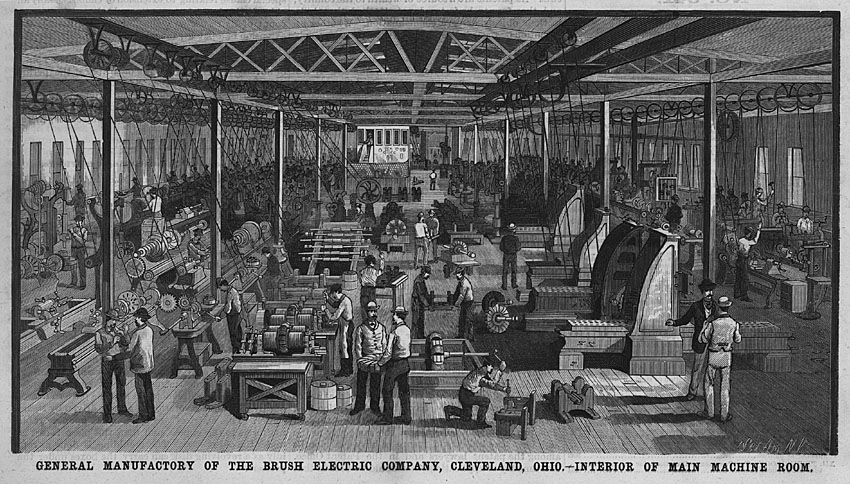
Cleveland’s most iconic innovative company of the era: Brush Electric Company. At one point, Brush manufactured 80% of the nation’s arc lights.

No discussion on the history of IPOs would be complete without covering Venture Capital and the financing of private companies. While today we think of innovation and technological breakthroughs only occurring in coastal cities like San Francisco and New York, this paper looks at the original Silicon Valley: 19th century Cleveland. I’m serious.

“During the Second Industrial Revolution of the late nineteenth and early twentieth centuries, Midwestern cities were important centers of innovation. Cleveland, the focus of this study, led in the development of a number of key industries, including electric light and power, steel, petroleum, chemicals, and automobiles, and was a hotbed of high-tech startups, much like Silicon Valley today.

In an era when production and invention were increasingly capital-intensive, technologically creative individuals and firms required greater access to funds than ever before. This paper explores how Cleveland’s leading inventors and technologically innovative firms obtained financing. We find that formal financial institutions, such as banks and securities markets, were of only limited significance. Instead our research highlights the vital role played by a small number of successful local enterprises that both exemplified the wealth-creation possibilities of the new technologies and served as hubs of overlapping networks of inventors and financiers. We conclude by suggesting that such nodal firms have spawned important clusters of innovative enterprises in other places and times as well.”

Cleveland: The Original Silicon Valley

“The continued growth both of local brokerage houses and of trading in local securities resulted in 1900 in the formal organization of the Cleveland Stock Exchange….

As was the case for other exchanges at that time, railroads initially dominated the listings. Compared to the New York Stock Exchange, however, the Cleveland market from the beginning handled the securities of a more diverse set of firms. For example, 52 percent of the firms listed on the New York Stock Exchange in 1900 were railroads, and in 1910 the figure was still 48 percent. By contrast, railroads accounted for only 40 percent of the listings on the Cleveland exchange in 1903, and by 1910 the share had fallen to 15 percent. This decline in the relative position of railroads on the CSE owed mainly to the listing of new banks, trust companies and utilities, including several local electric light companies and nine local telephone companies. Between 1910 and 1914, however, the number of manufacturing firms on the CSE more than doubled. The newly listed manufacturers included some of the most successful of the innovative firms formed over the previous several decades (American Multigraph; the Bishop-Babcock-Becker Company; Brown Hoisting Machine; National Carbon; Wellman-Seaver-Morgan, and the White Company).

The important point to underscore, however, is that these firms did not turn to the CSE to raise capital. Nor did their largest shareholders use the market to increase the liquidity of their investments. Trading in the equities of these manufacturing firms was at best light, and it seems that the listings were mainly useful to local brokers who from time to time had small lots of these securities to offer the public. Although venture capitalists today often make their profits by taking firms public and then cashing out their investments, that does not seem to have been the practice in the early twentieth century. To the contrary, investors in start-up enterprises appear to have planned to receive their profits over the long run in the form of dividends on their shareholdings.“

The Brush Electric Company

“Looking for a dramatic way to publicize Brush’s invention, Stockly and his associates negotiated a contract with the city of Cleveland to light Monumental Park (now Public Square). Advance publicity brought out a large crowd the evening of April 29, 1879, when Cleveland officials threw a switch, and twelve strategically placed arc lamps flooded the park with light. News of the event spread quickly throughout the country, generating a rush of interest in this new type of street lighting, followed by orders for installations. The successful demonstration also helped the officers of Telegraph Supply line up investors, and the next year the firm was reorganized as the Brush Electric Company with an authorized capital of $3 million, an enormous amount for the time.

Brush Electric installed about eighty percent of the nation’s arc-lighting systems during the early 1880s and made the business people who initially bought its stock rich. As Jacob D. Cox, founder of the Cleveland Twist Drill Company, later regretfully noted: “The original holders made immense sums of money but, as I had no funds to invest, I missed this rare opportunity”. Brush himself became a wealthy man, earning royalties on his patents in excess of $200,000 a year during 1882 and 1883. Indeed, his royalty account accumulated so quickly that the company fell behind on its payments, and to settle the debt, Brush agreed in 1886 to take $500,000 in stock. By the second half of the decade, however, the company was losing ground to new competitors, and Brush, Stockly, and the other major shareholders sold out to the Thomson Houston Electric Company at what appears to have been a handsome price. According to a report in the New York Times, the controlling shareholders (Stockly, Tracy, Leggett, Brush, and Stockly’s sister) owned 30,000 of the company’s 40,000 outstanding shares and sold them for $75 each. The par value of the stock was $50, and its market price was estimated at that time to be $35.”

The Theranos of 19th Century Cleveland

Just like Silicon Valley today, Cleveland had its fair share of enterprising frauds. One particular example is reminiscent of Elizabeth Holmes and Theranos attempts to raise money without actually possessing a viable product. The excerpt below describes the electric light industry’s “wild cat” companies that manufactured no products, but still pumped and dump stock with gullible investors by stealing legitimate company’s products and using them in pitches as if they were the company’s. This passage comes from an 1881 issue of the New York Times:

The Role of Financial Institutions

In short, the role of financial institutions was actually very small, even non-existent at times. What is particularly interesting about this historical parallel for Silicon Valley and VCs today is that these original “Venture Capitalists” were more interested in obtaining a return on their investments through long-term growth and dividends as opposed to seeking exits through an IPO or buyout (as is the case today).

“The wealthy Clevelanders who bought shares in these new high-tech enterprises seem to have been motivated by the returns they expected to earn from owning and holding them rather than by the profits they could reap by selling them off after an initial run-up in price. Although a few investors cashed out their investments relatively early (as Lawrence did when he sold off his Brush stock), this practice seems to have been quite uncommon. A search of Cleveland newspapers indicates, for example, that from the time of the formation of the Brush Electric Company until the late 1880s, when the idea of selling or merging the firm was beginning to be discussed, the only mention of Brush shares available on the market occurred around the time Lawrence was selling out. Before the formation of the Cleveland Stock Exchange in 1900, the only firms associated with the Brush hub for which share prices were quoted in the Cleveland papers were Brush Electric itself and the Walker Manufacturing Company. Even after the formation of the exchange, we do not see much trading in the equities of concerns associated with this hub.“


on wearing masks - Random Thoughts from the Frontline - Mauldin Economics

Random Thoughts from the Frontline - Mauldin Economics

I know that some think that masks are pointless and don’t help. Scientific studies say they do, but the anecdotal evidence from a conference that my good friend Peter Diamandis (medical doctor, research scientist, futurist, and founder of the X Prize) just finished showed otherwise.

They had a small group of live participants (along with hundreds of video participants) who were tested before anyone came and were tested every day during the conference. By the end, a significant portion of the attendees had acquired COVID-19, including Peter. He wrote a moving mea culpa.

Interestingly, they had 17 production staff, who all wore masks and intermingled with the unmasked participants. They were tested, too, and not one came down with the virus. This is as close to a laboratory experiment as you’re going to get.

S&P 500 value relative to interest rates - Random Thoughts from the Frontline - Mauldin Economics

Random Thoughts from the Frontline - Mauldin Economics

But persistent low rates might mean stock market valuations are actually in the fair value range.

Look at this next chart showing S&P 500 value relative to interest rates. Interest rates are 1.6 standard deviations below the trendline.

That suggests that the S&P 500 may not be so overpriced.


Source: CurrentMarketValuation.com

Covid Pandemic: How Youyang Gu Used AI and Data to Make Most Accurate Prediction - Bloomberg

Covid Pandemic: How Youyang Gu Used AI and Data to Make Most Accurate Prediction - Bloomberg

The 27-Year-Old Who Became a Covid-19 Data Superstar

 In the contest over who could make the most accurate coronavirus forecast, it was global institutions vs. a guy living with his parents in Santa Clara.

By

February 19, 2021, 11:00 AM GMT


Spring 2020 brought with it the arrival of the celebrity statistical model. As the public tried to gauge how big a deal the coronavirus might be in March and April, it was pointed again and again to two forecasting systems: one built by Imperial College London, the other by the Institute for Health Metrics and Evaluation, or IHME, based in Seattle.


But the models yielded wildly divergent predictions. Imperial warned that the U.S. might see as many as 2 million Covid-19 deaths by the summer, while the IHME forecast was far more conservative, predicting about 60,000 deaths by August. Neither, it turned out, was very close. The U.S. ultimately reached about 160,000 deaths by the start of August.


The huge discrepancy in the forecasting figures that spring caught the attention of a then 26-year-old data scientist named Youyang Gu. The young man had a master’s degree in electrical engineering and computer science from the Massachusetts Institute of Technology and another degree in mathematics, but no formal training in a pandemic-related area such as medicine or epidemiology. Still, he thought his background dealing with data models could prove useful during the pandemic.


In mid-April, while he was living with his parents in Santa Clara, Calif., Gu spent a week building his own Covid death predictor and a website to display the morbid information. Before long, his model started producing more accurate results than those cooked up by institutions with hundreds of millions of dollars in funding and decades of experience.


“His model was the only one that seemed sane,” says Jeremy Howard, a renowned data expert and research scientist at the University of San Francisco. “The other models were shown to be nonsense time and again, and yet there was no introspection from the people publishing the forecasts or the journalists reporting on them. Peoples’ lives were depending on these things, and Youyang was the one person actually looking at the data and doing it properly.”


The forecasting model that Gu built was, in some ways, simple. He had first considered examining the relationship among Covid tests, hospitalizations, and other factors but found that such data was being reported inconsistently by states and the federal government. The most reliable figures appeared to be the daily death counts. “Other models used more data sources, but I decided to rely on past deaths to predict future deaths,” Gu says. “Having that as the only input helped filter the signal from the noise.”


The novel, sophisticated twist of Gu’s model came from his use of machine learning algorithms to hone his figures. After MIT, Gu spent a couple years working in the financial industry writing algorithms for high-frequency trading systems in which his forecasts had to be accurate if he wanted to keep his job. When it came to Covid, Gu kept comparing his predictions to the eventual reported death totals and constantly tuned his machine learning software so that it would lead to ever more precise prognostications. Even though the work required the same hours as a demanding full-time job, Gu volunteered his time and lived off his savings. He wanted his data to be seen as free of any conflicts of interest or political bias.


While certainly not perfect, Gu’s model performed well from the outset. In late April he predicted the U.S. would see 80,000 deaths by May 9. The actual death toll was 79,926. A similar late-April forecast from IHME predicted that the U.S. would not surpass 80,000 deaths through all of 2020. Gu also predicted 90,000 deaths on May 18 and 100,000 deaths on May 27, and once again got the numbers right. Where IHME expected the virus to fade away as a result of social distancing and other policies, Gu predicted there would be a second, large wave of infections and deaths as many states reopened from lockdowns.


IHME faced some criticism in March and April, when its numbers didn’t match what was happening. Still, the prestigious center, based at the University of Washington and bolstered by more than $500 million in funding from the Bill & Melinda Gates Foundation, was cited on an almost daily basis during briefings by members of President Donald Trump’s Administration. In April, U.S. infectious-disease chief Anthony Fauci told an interviewer that Covid’s death toll “looks more like 60,000 than the 100,000 to 200,000” once expected—a prediction that reflected IHME forecasts. And on April 19, the same day Gu cautioned about a second wave, Trump pointed to IHME’s 60,000-death forecast as an indicator that the fight against the virus would soon be over.


IHME officials also actively promoted their numbers. “You had the IHME on all these news shows trying to tell people that deaths would go to zero by July,” Gu says. “Anyone with common sense could see we would be at 1,000 to 1,500 daily deaths for a while. I thought it was very disingenuous for them to do that.”


Christopher Murray, the director of IHME, says that once the organization got a better handle on the virus after April, its forecasts radically improved.


But that spring, week by week, more people started to pay attention to Gu’s work. He flagged his model to reporters on Twitter and e-mailed epidemiologists, asking them to check his numbers. Toward the end of April, the prominent University of Washington biologist Carl Bergstrom tweeted about Gu’s model, and not long after that the U.S. Centers for Disease Control and Prevention included Gu’s numbers on its Covid forecasting website. As the pandemic progressed, Gu, a Chinese immigrant who grew up in Illinois and California, found himself taking part in regular meetings with the CDC and teams of professional modelers and epidemiologists, as everyone tried to improve their forecasts.


Traffic to Gu’s website exploded, with millions of people checking in daily to see what was happening in their states and the U.S. overall. More often than not, his predicted figures ended up hugging the line of actual death figures when they arrived a few weeks later.


With such intense interest around these forecasts, more models began to appear through the spring and summer of 2020. Nicholas Reich, an associate professor in the biostatistics and epidemiology department at the University of Massachusetts, Amherst, collected the 50 or so models and measured their accuracy over many months at the Covid-19 Forecast Hub. “Youyang’s model was consistently among the top,” Reich says.


In November, Gu decided to wind down his death forecast operation. Reich had been blending the various forecasts and found that the most accurate predictions came from this “ensemble model,” or combined data.


“Youyang stepped back with a remarkable sense of humility,” Reich says. “He saw the other models were doing well and his work here was done.” A month before stopping the project, Gu had predicted that the U.S. would record 231,000 deaths on Nov. 1. When Nov. 1 arrived, the U.S. reported 230,995 deaths.


The IHME’s Murray has his own take on Gu’s exit. He says Gu’s model would not have picked up on the seasonal nature of the coronavirus and would have missed the winter surge in cases and deaths. “He had the epidemic going away in the winter, and we had picked up that there was seasonality as early as May,” Murray says.


The machine learning methods used by Gu work well at short-range predictions, Murray says, but “are not very good at understanding what is going on” in the bigger picture. The algorithms, based on the past, can’t account for virus variants and how well vaccines may or may not work against them, according to Murray. For its part, IHME called the early peak of the virus correctly, then erred when it came to predicting a steep decline in deaths until it adjusted its model to better reflect reality. “We got it wrong the first of April,” Murray says. “Since then we are the only group that has gotten it right consistently.”


Reich, who compiles the list of the major models, said that the organization’s predictions later in the pandemic were passable. “Early on, IHME’s model didn’t do what it advertised,” Reich says. “More recently, it has been a reasonable model. I would not say it is one of the best, but it is reasonable.”


Gu declined to address Murray’s remarks about his model. Instead, he offers a data scientist’s version of a backhanded compliment. “I’m very appreciative of Dr. Chris Murray and his team for the work they did,” Gu says. “Without them, I would not be in the position I am today.”


To the extent that we can learn from this data story, Reich asks that people not rush to place too much faith in early individual models the next time a pandemic arrives. He also questions whether forecasts beyond six to eight weeks out will ever be very accurate. Ideally, the CDC and others will be quicker to combine models and distribute the blended data in the future. “I hope we will invest the time, energy, and money into setting up a system that is more ready to respond with a wider array of models closer to the get-go,” Reich says. “We have to have people ready, instead of going around and knocking on peoples’ doors.”


After taking a bit of a break, Gu, now 27 and living in a New York apartment, did get back into the modeling game. This time, he’s creating figures related to how many people in the U.S. have been infected by Covid-19, how quickly vaccines are being rolled out, and when, if ever, the country might reach herd immunity. His forecasts suggest that about 61% of the population should have some form of immunity—either from the vaccine or past infection—by June.


Before the pandemic, Gu hoped to start a new venture, possibly in sports analytics. Now he’s considering sticking to public health. He wants to find a job where he can have a large impact while avoiding politics, bias, and the baggage that sometimes comes with large institutions. “There are a lot of shortcomings in the field that could be improved by people with my background,” he says. “But I still don’t know quite how I would fit in.”